
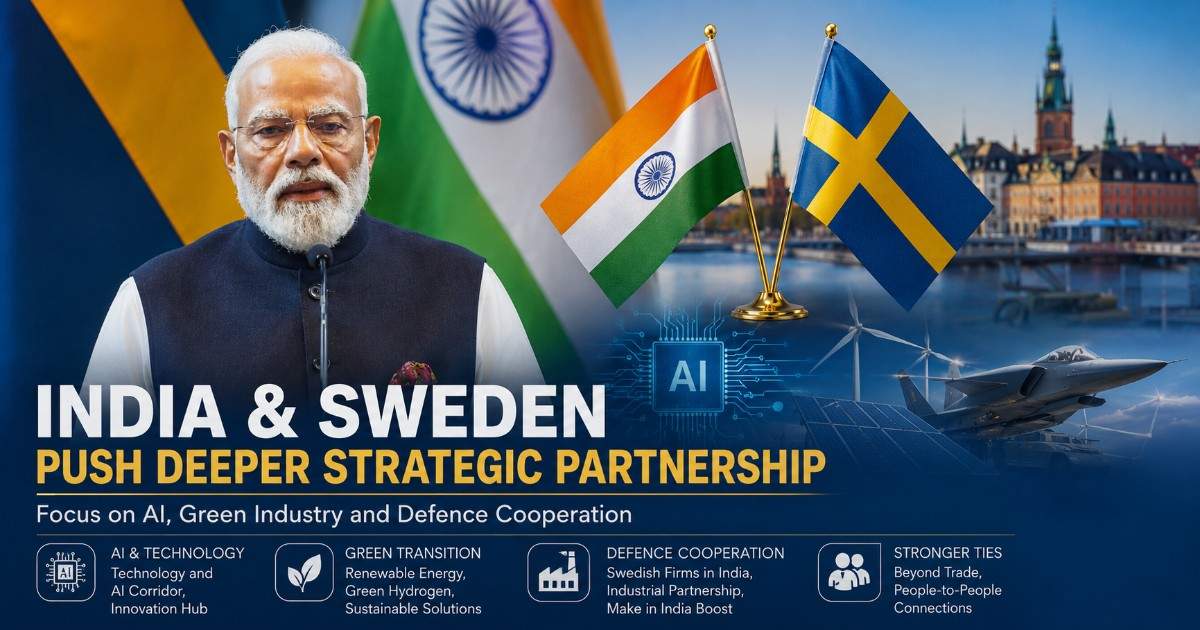
Prime Minister Narendra Modi signalled a broader expansion of India’s partnership with Sweden during his address at the European Round Table for Industry in Gothenburg, outlining a roadmap that places emerging technologies, sustainable industry and defence manufacturing at the centre of bilateral cooperation.
The remarks come at a time when India is intensifying engagement with European partners amid shifting geopolitical alignments, supply-chain diversification efforts and growing competition around advanced technologies such as artificial intelligence and clean energy systems.
Addressing business leaders and policymakers alongside Swedish Prime Minister Ulf Kristersson and European Commission President Ursula von der Leyen, Modi said democratic nations must deepen cooperation to support global stability and resilient economic growth.
Strategic Partnership Moves Beyond Trade
India and Sweden have maintained steadily expanding ties for years, particularly in sectors including manufacturing, sustainability, telecommunications and urban infrastructure. However, the latest discussions suggest an attempt to elevate the relationship beyond conventional trade engagement into a more strategic technology-driven partnership.
Modi described innovation, democratic governance and sustainable development as common strengths binding the two countries. He said future collaboration would increasingly focus on green transition projects, advanced manufacturing, emerging technologies and stronger people-to-people exchanges.
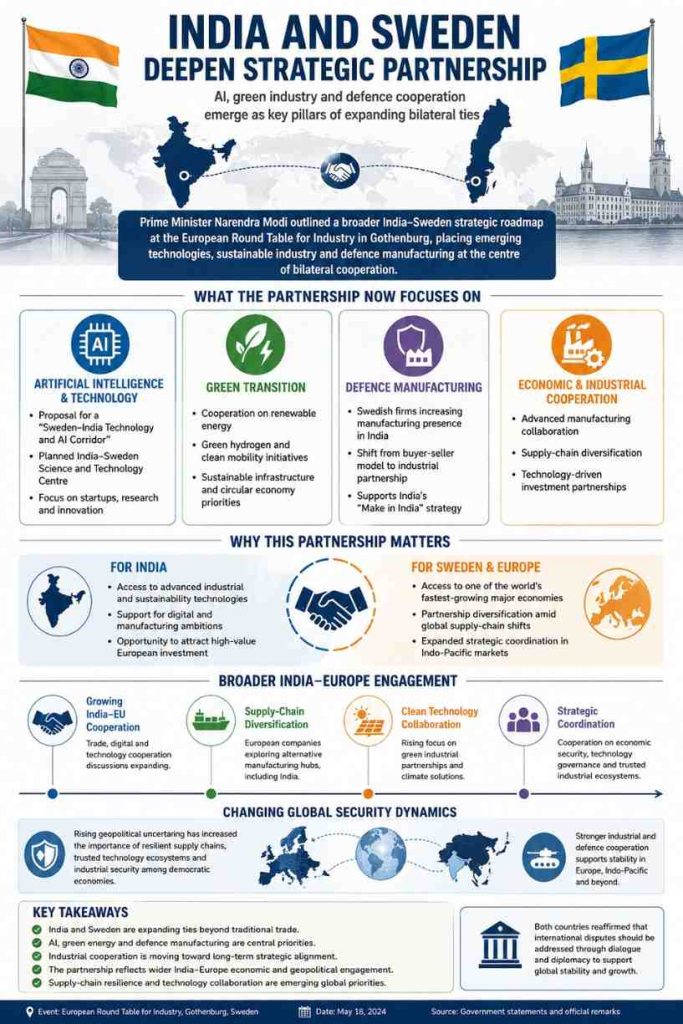
A major emphasis of the discussions centred on artificial intelligence and technology collaboration. India proposed advancing a “Sweden–India Technology and AI Corridor,” alongside plans for an India–Sweden Science and Technology Centre aimed at strengthening research cooperation, startup ecosystems and industrial innovation.
The announcement reflects India’s broader ambition to position itself as a global digital and manufacturing hub while attracting European investment into high-value sectors.
Green Transition Emerging as Core Area
Climate and energy cooperation also featured prominently in Modi’s remarks. India has been expanding investments in renewable energy, green hydrogen, electric mobility and circular economy initiatives as part of its long-term decarbonisation goals.
Sweden, meanwhile, is widely recognised for advanced industrial sustainability technologies, low-carbon manufacturing systems and innovation in clean mobility solutions.
Modi argued that combining Swedish technological expertise with India’s production scale and market size could create globally relevant solutions in areas such as sustainable infrastructure, energy transition and industrial decarbonisation.
The emphasis on green collaboration aligns with growing India-Europe cooperation on climate-focused industrial policy. European companies are increasingly exploring partnerships in India as businesses seek alternative manufacturing destinations and long-term clean-energy markets.
Defence Cooperation Signals Structural Shift
One of the more strategically significant aspects of Modi’s address involved defence cooperation. He pointed to Swedish companies establishing manufacturing operations in India as evidence that the relationship is evolving from a traditional buyer-seller arrangement toward long-term industrial collaboration.
This shift aligns with India’s broader “Make in India” defence manufacturing strategy, which seeks to reduce import dependence and expand domestic production capabilities through foreign partnerships and technology transfer arrangements.
Sweden is home to several globally recognised defence and aerospace firms, and deeper industrial cooperation could support India’s efforts to modernise defence infrastructure while strengthening local supply chains.
Analysts note that European defence partnerships have gained renewed importance as geopolitical tensions reshape security calculations across both Europe and the Indo-Pacific region.
India-Europe Engagement Expanding
Modi’s comments also reflect India’s wider diplomatic push to strengthen engagement with Europe on economic security, technology governance and strategic coordination.
India and the European Union have accelerated talks in recent years on trade, digital cooperation, clean technology partnerships and resilient supply chains. The increasing focus on trusted technology ecosystems and democratic alignment has further reinforced cooperation between India and European nations.
Without directly referencing ongoing global conflicts, Modi reiterated India’s position that international disputes should be addressed through dialogue and diplomacy. The statement comes amid continuing geopolitical uncertainty involving Europe, West Asia and Indo-Pacific security dynamics.
Why the Partnership Matters
For India, deeper engagement with Sweden offers access to advanced industrial technology, sustainability expertise and innovation ecosystems that can support long-term economic transformation goals.
For Sweden and Europe, India represents one of the world’s fastest-growing major economies, a significant consumer market and an increasingly important strategic partner in technology and manufacturing diversification.
The partnership also carries broader geopolitical significance. As democratic economies seek more resilient supply chains and reduced dependence on concentrated manufacturing networks, collaborations between India and technologically advanced European nations are becoming more strategically valuable.
While several of the initiatives discussed remain at the planning stage, the emphasis on AI, green technology, industrial cooperation and defence manufacturing suggests that India-Sweden relations are entering a more ambitious phase with long-term strategic implications beyond bilateral trade alone.
Key Highlights
- Prime Minister Narendra Modi said India and Sweden are expanding ties beyond traditional trade, with a stronger focus on technology, green industry and strategic cooperation.
- Speaking at the European Round Table for Industry in Gothenburg, Modi highlighted artificial intelligence, advanced manufacturing and sustainable development as key pillars of future collaboration.
- India proposed a “Sweden–India Technology and AI Corridor” and plans for an India–Sweden Science and Technology Centre to strengthen innovation, research and startup cooperation.
- Green transition emerged as a major area of partnership, with both countries looking to collaborate on renewable energy, green hydrogen, clean mobility and industrial sustainability solutions.
- Modi said Swedish companies setting up manufacturing operations in India reflect a shift in defence ties from a buyer-seller relationship toward long-term industrial and production partnerships.
- The discussions come amid wider India-Europe efforts to strengthen cooperation on supply chains, digital technologies, economic security and trusted industrial ecosystems.
- The India-Sweden partnership is gaining broader geopolitical importance as democratic economies seek resilient manufacturing networks and deeper strategic coordination in a changing global environment.
Input & Images : Hindusthan Samachar
Edited by Madhusudhan Reddy
Add newsproton.com as preferred source on google – Click here
Also Read – https://newsproton.com/delhi-government-announces-two-day-work-from-home-policy-and-fuel-saving-measures/
Last Updated on: Monday, May 18, 2026 11:26 am by Madhusudhan Reddy | Published by: Madhusudhan Reddy on Monday, May 18, 2026 11:21 am | News Categories: Trending, Technology