
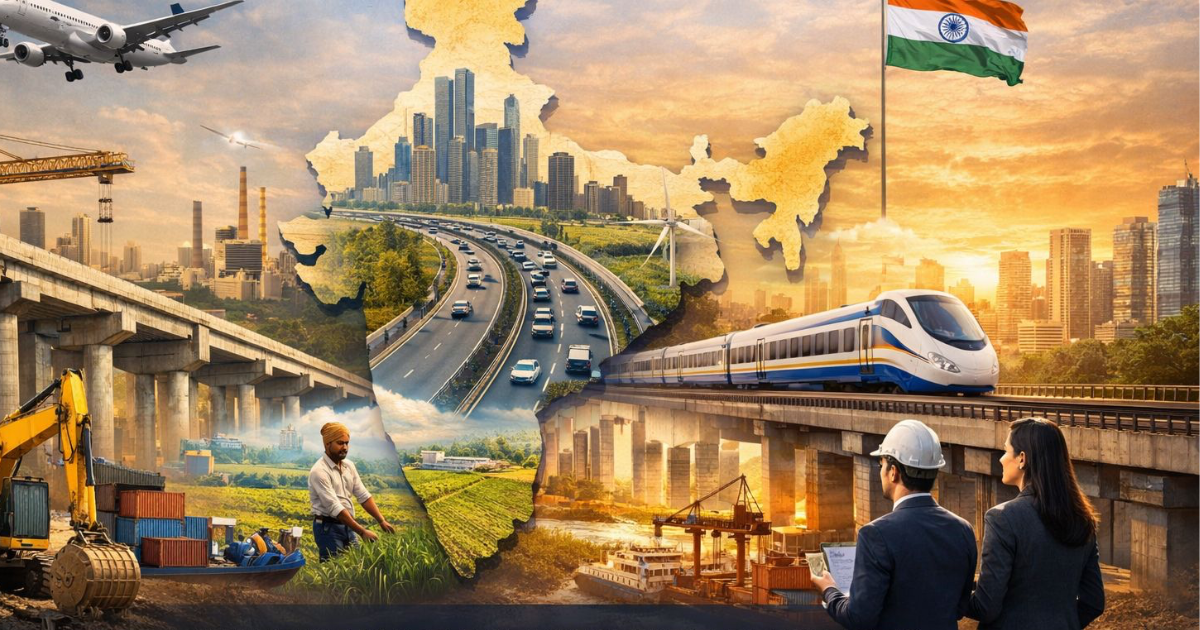
New Delhi, January 2026: The Indian government’s ambitious infrastructure drive is entering a crucial phase in 2025–26, with major projects across highways, urban development, rural connectivity and industrial nodes gaining fresh traction. These initiatives not only aim to overhaul the physical landscape of the nation but are also beginning to show measurable impacts on local economies — from job creation and improved mobility to enhanced access to markets and services.
1. Roads, Expressways and Regional Connectivity: Redrawing Economic Maps
One of the most visible indicators of India’s infrastructure push has been the rapid expansion of highway networks and expressways.
Delhi–Mumbai Expressway: Game Changer for Inter-City Commerce
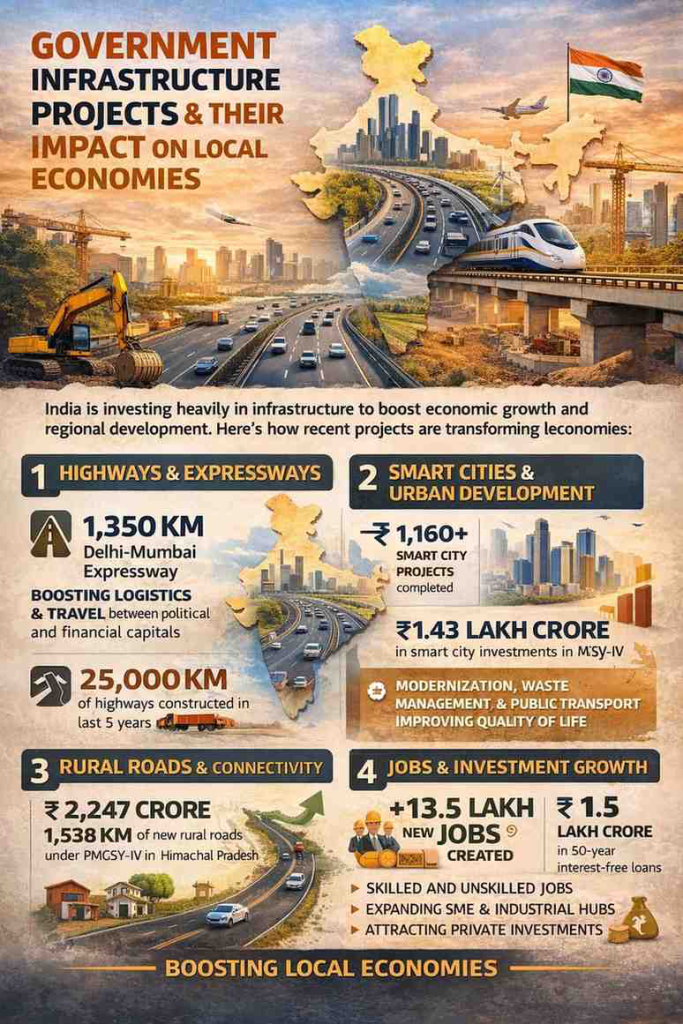
The Delhi–Mumbai Expressway, India’s largest greenfield expressway project, continues to advance toward full operation by late 2025. Stretching over 1,350 km, this corridor will drastically shorten travel time between India’s political and financial capitals and is expected to usher in a new logistics era for industries, particularly manufacturing and perishable goods transport — a key catalyst for regional economic integration.
Panipat–Dabwali and Other Arterials: Boosting Local Economies
Complementing national highways are regional projects like the Panipat–Dabwali Expressway, set to slash travel time within Haryana and neighboring regions, reduce transport costs, and stimulate ancillary sectors such as warehousing and small-scale manufacturing.
Orbital Rail and Northeastern Rail Links
Rail connectivity also remains critical. The Haryana Orbital Rail Corridor promises to inject fresh life into satellite towns around the National Capital Region by integrating freight and passenger services with major industrial hubs. Meanwhile, the North Eastern Railway Connectivity Project — linking all capitals in the Northeast — is reshaping this historically under-connected region, opening doors to trade with neighbouring countries and diversifying local livelihoods.
2. Urban and Rural Infrastructure: Bridging Divides in Quality of Life
Smart Cities Mission: Urban Renewal and Economic Efficiencies
Under the Smart Cities Mission, more than 7,160 projects worth ₹1,43,778 crore have been completed across India’s cities, with initiatives spanning waste-to-energy systems, intelligent transport management, and upgraded utilities that enhance business environments and quality of life for residents.
From expanded CCTV networks improving urban safety to SCADA-enabled water systems cutting leakages, these investments not only improve livability but also strengthen local entrepreneurship and small business growth.
Pradhan Mantri Gram Sadak Yojana (PMGSY): Rural Connectivity
In Himachal Pradesh, the approval of 294 rural road works covering 1,538 km under PMGSY-IV, backed by ₹2,247 crore funding, is a testament to renewed focus on rural connectivity. Such projects reduce rural isolation, facilitating easier access to markets, schools and healthcare — with cascading benefits for agricultural incomes and microenterprises.
Urban Parking and Traffic Solutions
Even smaller urban projects like proposed multi-level parking facilities near major hospitals in Prayagraj signal a recognition that reducing urban congestion directly improves economic throughput in city centers by enabling smoother commerce and better emergency access.
3. Industrial Nodes, Policy Support and Strategic Investments
State-Level Policy Initiatives
In Rajasthan, the cabinet’s approval of Aerospace and Semiconductor policies aims to position the state as a hub for advanced manufacturing, linking MSMEs, startups, and global investors with targeted incentives such as tax breaks and land subsidies.
Through policies that foster technological clusters, states are ensuring that infrastructure development does not remain limited to physical assets but becomes a foundation for high-value, knowledge-based economic growth.
Union Budget Infra Support
The Union Budget 2025 backed infrastructure with historic fiscal support, including Rs. 1.5 lakh crore in 50-year interest-free loans to states and the creation of an Urban Challenge Fund to turn cities into growth hubs. These financial mechanisms unlock capital for large-scale projects and encourage innovation from the ground up.
4. Local Economic Impact: What the Numbers and Studies Show
Job Creation and Investment Flows
Improved connectivity drives local employment — in construction, logistics, hospitality and services. Major expressways and rail corridors attract private investments into logistics parks, warehouses and industrial clusters, while urban infrastructure projects create tangible improvements that support small businesses and residential markets.
Boost to SMEs and Peripheral Sectors
According to global economic analysis frameworks, enhanced accessibility from public transport and road investments leads to measurable upticks in local economic activity, particularly for microenterprises that cluster around transport nodes. For example, studies of metro expansions internationally show increases in economic output and business formations in connected zones.
Quality of Life and Long-Term Resilience
By improving water, waste, electricity and transit infrastructures, cities and rural towns alike are becoming more resilient and attractive for long-term investment. Durable infrastructure reduces cost burdens for local firms and raises real estate values for communities.
5. Challenges and Next Steps
Despite progress, challenges remain — project delays, regulatory hurdles, land acquisition issues, and the need for better integration between infrastructure planning and local economic strategies are ongoing concerns. Streamlining permitting and speeding up implementation will be vital to maximizing economic advantages from these public investments.
Conclusion: Infrastructure as an Engine of Inclusive Growth
India’s infrastructure narrative in 2025–26 is more than bricks and steel. It is about transforming how people live, work and connect — from the heartlands of rural districts to burgeoning urban centers. As major expressways near completion, smart city projects reshape urban landscapes, and connectivity deepens to once-remote regions, the nation stands at a pivotal moment: leveraging infrastructure not just for connectivity but as a strategic catalyst for inclusive, sustainable local economic development.
Also read :https://newsestate.in/how-recent-policy-decisions-could-influence-indias-economic-growth-outlook/
Add newsproton.com as a preferred source on google – click here
Last Updated on: Thursday, January 22, 2026 12:48 pm by News Proton Team | Published by: News Proton Team on Thursday, January 22, 2026 12:48 pm | News Categories: News