
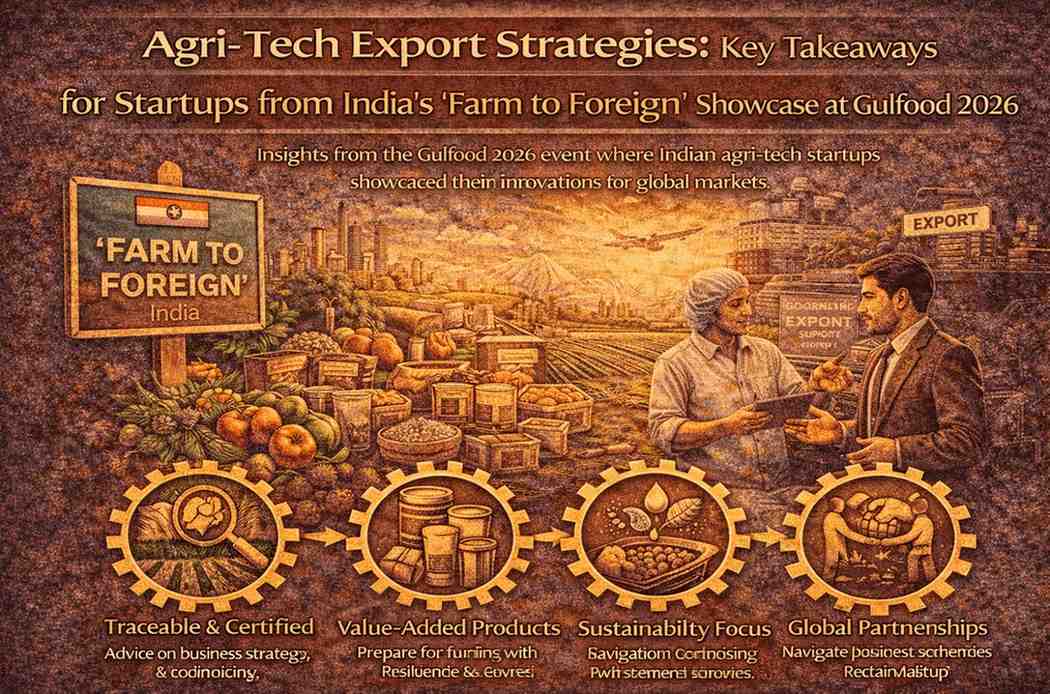
India’s agri-tech sector stepped into the global spotlight at Gulfood 2026 with the government-led ‘Farm to Foreign’ showcase, signalling a clear shift in how Indian agriculture and food innovation are positioned for international markets. The event brought together agri-tech startups, exporters, policymakers, and global buyers, offering valuable insights into how technology-led agricultural ventures can scale exports and compete globally. For Indian startups, the showcase was not just about visibility but about understanding what it takes to build export-ready agri-tech businesses.
India’s ‘Farm to Foreign’ Vision at Gulfood 2026
The ‘Farm to Foreign’ initiative reflects India’s broader ambition to move up the global agricultural value chain. Rather than exporting raw produce alone, the focus is increasingly on processed foods, traceable supply chains, value-added products, and tech-enabled agri solutions.
At Gulfood 2026, India showcased a diverse mix of offerings, ranging from smart farming technologies and agri-input platforms to processed foods, organic produce, and export-focused supply chain solutions. The presence of startups alongside established exporters underscored the growing role of innovation in shaping India’s agri-export strategy.
Why Agri-Tech Startups Matter in the Export Push
Agri-tech startups are uniquely positioned to solve some of the biggest challenges in agricultural exports, including quality consistency, traceability, compliance, and logistics efficiency. Global buyers increasingly demand transparency, sustainability, and predictable supply—areas where technology can make a decisive difference.
The Gulfood showcase highlighted how startups can act as enablers rather than just sellers. By digitising procurement, improving farm-level practices, and ensuring end-to-end traceability, agri-tech companies help bridge the gap between Indian farmers and global markets.
Understanding Global Buyer Expectations
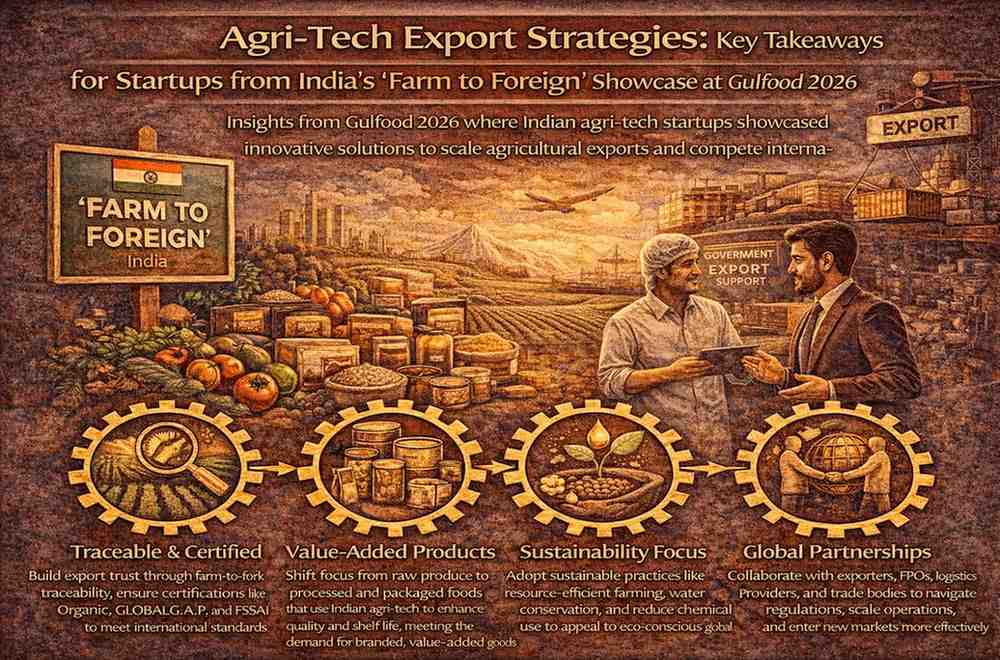
One of the clearest lessons from Gulfood 2026 was the evolving expectations of international buyers. Price competitiveness remains important, but it is no longer sufficient. Buyers are placing greater emphasis on food safety standards, certifications, traceability, and sustainability credentials.
Startups observed that buyers want reliable partners who can ensure consistent quality across shipments and seasons. Agri-tech solutions that offer real-time data, quality monitoring, and compliance tracking are increasingly seen as value-adds rather than optional features.
Export Readiness Goes Beyond Technology
While technology is a critical enabler, export success requires a broader understanding of global trade dynamics. Startups at the ‘Farm to Foreign’ showcase noted that regulatory compliance, packaging standards, documentation, and logistics planning are just as important as product innovation.
Many young agri-tech firms realised that export readiness involves building internal capabilities around international certifications, market-specific regulations, and supply chain resilience. Those that combined technical innovation with strong operational fundamentals attracted greater interest from global partners.
Role of Value Addition and Processing
A key theme at Gulfood 2026 was India’s push toward value-added agricultural exports. Instead of exporting commodities alone, the emphasis is shifting to processed, branded, and differentiated products that command higher margins.
Agri-tech startups working in food processing, post-harvest management, and cold-chain logistics found strong demand for their solutions. Technologies that reduce wastage, extend shelf life, and improve packaging directly support export scalability and profitability.
Sustainability as a Market Differentiator
Sustainability emerged as a major differentiator in global agri markets. Buyers showed strong interest in products and platforms that promote climate-smart agriculture, water efficiency, and reduced chemical usage.
For Indian agri-tech startups, this reinforces the importance of embedding sustainability into their core value proposition. Solutions that help farmers adopt sustainable practices not only improve long-term productivity but also enhance export appeal in environmentally conscious markets.
Leveraging Traceability and Digital Proof
Traceability was one of the most discussed topics at the showcase. Global buyers increasingly expect digital proof of origin, quality, and compliance. Agri-tech platforms offering farm-level traceability, blockchain-based records, and data-backed certifications gained particular attention.
For startups, this highlights a clear export strategy opportunity. Building robust traceability systems can transform trust from a relationship-based factor into a verifiable, scalable asset.
Partnerships and Ecosystem Approach
Another key takeaway from Gulfood 2026 was the importance of partnerships. Successful export strategies often involve collaboration between startups, farmer producer organisations, exporters, logistics providers, and government agencies.
The ‘Farm to Foreign’ platform encouraged startups to think beyond standalone models and adopt ecosystem-based approaches. Partnerships help distribute risk, improve scale, and accelerate market entry, especially in unfamiliar international markets.
Government Support and Policy Alignment
Government presence at the showcase reinforced the role of policy support in enabling agri-tech exports. From export promotion schemes to quality certification support and market access facilitation, startups were encouraged to align their growth strategies with national export priorities.
For early-stage agri-tech companies, understanding and leveraging these support mechanisms can reduce barriers to entry and improve competitiveness in global markets.
What Startups Should Take Away
The Gulfood 2026 ‘Farm to Foreign’ showcase offered a clear message to Indian agri-tech startups: global ambition must be matched with global readiness. Export success depends on a combination of technology, operational discipline, compliance, and strategic partnerships.
Startups that position themselves as reliable, transparent, and sustainability-driven partners are more likely to succeed in international markets. Export strategies must be built early, not treated as an afterthought once domestic scale is achieved.
The Road Ahead for Agri-Tech Exports
India’s agri-tech export journey is still in its early stages, but momentum is clearly building. Events like Gulfood 2026 demonstrate that global markets are open to Indian innovation, provided startups meet evolving expectations.
Agri-tech export strategies will increasingly define the next phase of growth for the sector. By learning from the ‘Farm to Foreign’ showcase and aligning innovation with global demand, Indian startups have an opportunity to move from local impact to international leadership in the years ahead.
Add newsproton.com as preferred source on google – click here
Last Updated on: Tuesday, January 27, 2026 11:06 am by News Proton Team | Published by: News Proton Team on Tuesday, January 27, 2026 11:06 am | News Categories: India