
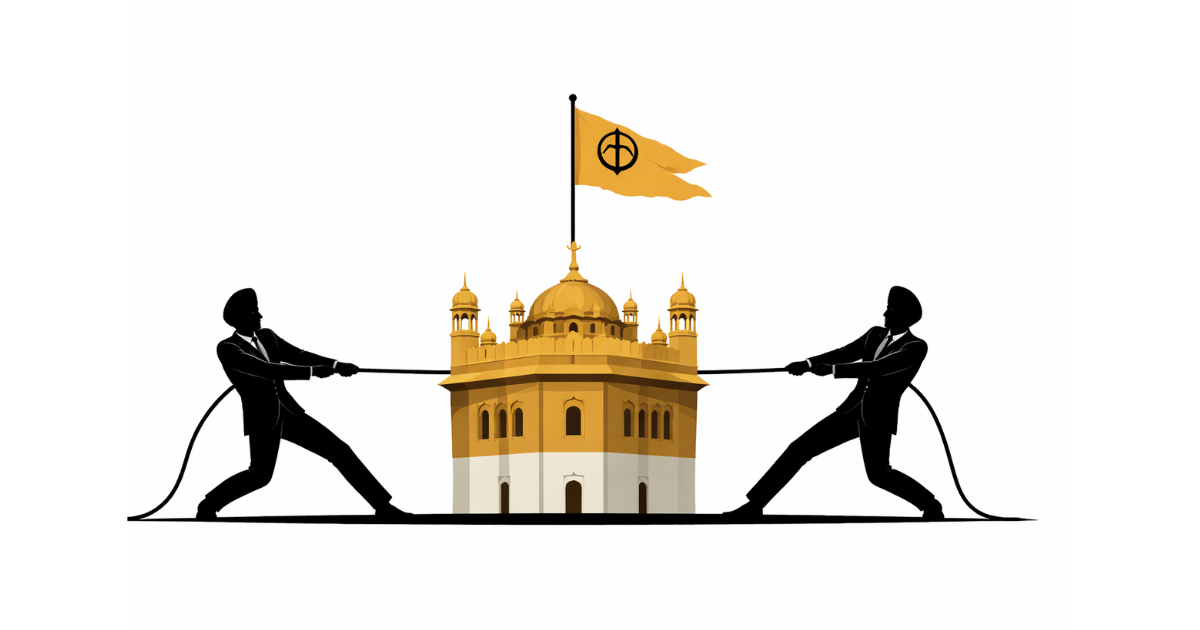
The ruling Aam Aadmi Party (AAP) in Punjab has launched a sharp political offensive with its social media campaign titled #SaveSGPCfromBadals, igniting widespread debate across the state’s political and religious landscape. The campaign, which quickly gained traction online, targets the long-standing influence of the Badal family over the Shiromani Gurdwara Parbandhak Committee (SGPC), the apex Sikh body responsible for managing gurdwaras and religious affairs in several states.
Aam Aadmi Party has framed the campaign as a call for transparency and reform within the SGPC, asserting that the institution should function independently and in the broader interest of the Sikh community. Party leaders in Punjab have publicly amplified concerns about alleged irregularities within the SGPC’s functioning and questioned what they describe as the continued dominance of leaders linked to the Badal political family.
The Shiromani Gurdwara Parbandhak Committee, established in 1920, plays a central role in Sikh religious administration. Over the decades, it has been closely associated with the Shiromani Akali Dal, particularly during periods when the party held political power in Punjab. The Badal family, especially former deputy chief minister Sukhbir Singh Badal, has been viewed as a key force within both the Akali Dal and SGPC-linked politics.
The current flashpoint emerged following public remarks by senior Sikh religious figures who raised concerns about governance and accountability within the SGPC. These remarks were widely circulated and subsequently picked up by AAP leaders, who used the moment to intensify their political messaging. The hashtag #SaveSGPCfromBadals began trending across social media platforms, reflecting a coordinated digital campaign aimed at mobilising public opinion.
AAP leaders have argued that religious institutions must remain free from what they call entrenched political control. They have also referenced past controversies involving the management of religious affairs, including debates around missing copies of the Guru Granth Sahib and the handling of related investigations. While these issues have been part of Punjab’s political discourse for years, the renewed spotlight has amplified tensions between the ruling party and the opposition.
In response, the Shiromani Akali Dal has strongly rejected AAP’s allegations, accusing the state government of politicising religious institutions for electoral gain. Party spokespersons have maintained that the SGPC is an autonomous body elected by Sikh voters and that attempts to interfere with its functioning undermine established democratic processes within the community. They have also argued that religion should not be used as a political battleground.
Public reaction has been mixed. Supporters of the campaign say it represents a necessary push for accountability and transparency in institutions that command deep respect among Sikhs worldwide. Critics, however, caution that aggressive political messaging around religious bodies risks widening divisions within the community. Social media discussions reveal both passionate endorsement and sharp criticism, reflecting the sensitive intersection of faith and politics in Punjab.
The development comes at a time when Punjab’s political climate remains highly competitive. With the next Assembly elections drawing closer, analysts see the campaign as part of a broader strategy to consolidate support among Sikh voters and challenge the historical dominance of the Akali Dal in religious institutional politics. The SGPC, given its symbolic and administrative significance, has often carried political weight beyond its formal mandate.
The debate also highlights a longstanding structural question in Punjab: the overlapping relationship between religious authority and political leadership. Since its formation, the SGPC has been intertwined with the region’s political evolution, particularly through the Akali movement. Efforts to reform or challenge that relationship have historically generated intense public engagement.
As the #SaveSGPCfromBadals campaign continues to circulate online, its impact will likely extend beyond digital platforms. Whether it results in tangible institutional changes or remains a political slogan will depend on legal, electoral and community responses in the months ahead. What is clear is that the campaign has reopened a critical conversation about governance, accountability and the balance between religion and politics in Punjab’s public life.
Add newsproton.com as preferred source on google – Click here
Disclaimer: The information presented in this article is intended for general informational purposes only. While every effort is made to ensure accuracy, completeness, and timeliness, data such as prices, market figures, government notifications, weather updates, holiday announcements, and public advisories are subject to change and may vary based on location and official revisions. Readers are strongly encouraged to verify details from relevant official sources before making financial, investment, career, travel, or personal decisions. This publication does not provide financial, investment, legal, or professional advice and shall not be held liable for any losses, damages, or actions taken in reliance on the information provided.
Last Updated on: Friday, February 20, 2026 12:45 pm by News Proton Team | Published by: News Proton Team on Friday, February 20, 2026 12:45 pm | News Categories: India