
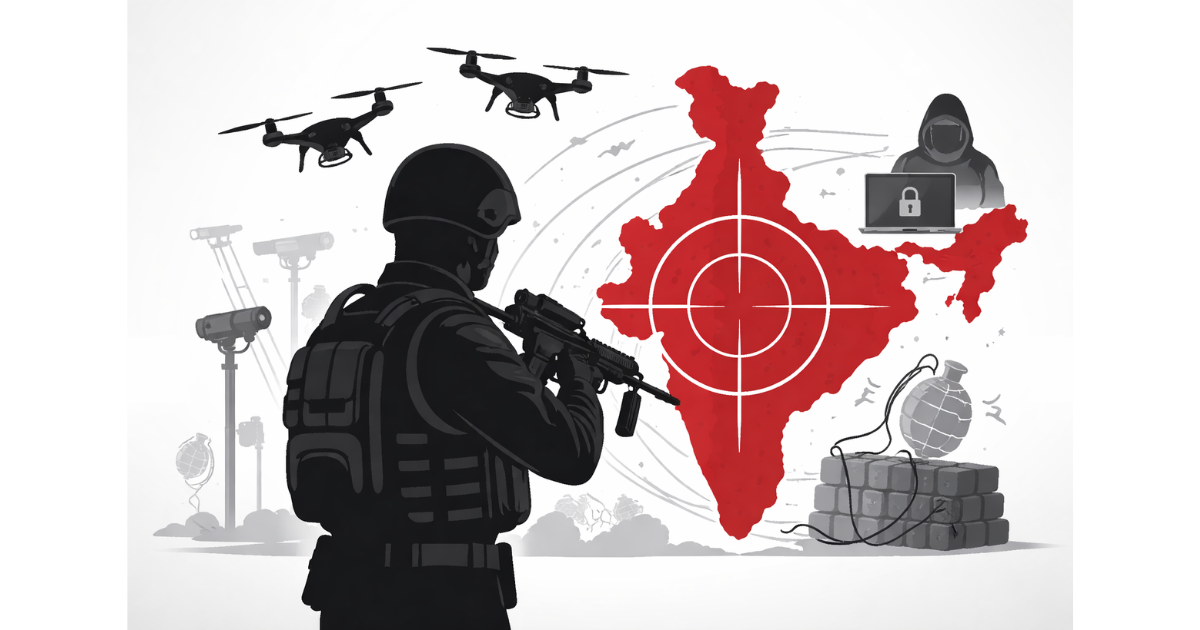
India has unveiled a comprehensive national counter-terrorism framework titled “PRAHAAR,” positioning it as a unified doctrine to address evolving threats ranging from cross-border terrorism to cyber-enabled radicalisation. Released by the Ministry of Home Affairs, the strategy lays out a coordinated, multi-layered approach that brings together intelligence, law enforcement, technology, legal frameworks and community engagement under a single policy architecture.
The doctrine comes at a time when the nature of terrorism is undergoing rapid transformation. Security assessments in recent years have highlighted not only traditional attack models but also the growing role of encrypted communications, drone deliveries, online propaganda, crypto-based financing and cyber sabotage. PRAHAAR seeks to treat these not as isolated threats but as interconnected components of a broader security ecosystem.
At its core, PRAHAAR rests on seven broad pillars: prevention, response, capacity aggregation, adherence to human rights and rule of law, reduction of enabling conditions such as radicalisation, alignment with international partners and recovery through societal resilience. The strategy does not create a new agency; instead, it attempts to synchronise existing institutions and mechanisms into a more cohesive operational structure.
Prevention is positioned as the primary line of defence. The document underscores an intelligence-guided approach anchored by the Multi Agency Centre, which functions as a real-time information-sharing hub. Intelligence inputs are coordinated through structures within the Intelligence Bureau to ensure swift dissemination to state and central agencies. The emphasis is on early detection and disruption of plots before they reach execution stages.
PRAHAAR also addresses the logistical backbone of terror networks. It flags concerns over the nexus between extremist groups and organised criminal syndicates, particularly in relation to illegal arms trafficking and financial flows. Legal mechanisms such as the Unlawful Activities (Prevention) Act and the Prevention of Money Laundering Act are cited as key instruments in choking funding channels and dismantling support structures.
On the operational front, the strategy clarifies response protocols in the event of an attack. Local police forces remain the first responders, supported by specialised state units and central forces. The National Security Guard is designated as the primary federal contingency force for major terror incidents, while the National Investigation Agency leads investigations in cases that fall under its statutory mandate. Standard operating procedures are intended to reduce coordination gaps during high-pressure scenarios, ensuring clarity in command and evidence handling.
Capacity building forms a central plank of PRAHAAR. The strategy calls for modernisation of equipment, enhanced training in urban combat and counter-drone operations, and greater technological readiness. Institutions such as the Bureau of Police Research and Development are expected to play a role in upgrading training modules and promoting best practices across states. The broader objective is to establish a more uniform baseline of anti-terror capabilities nationwide, reducing disparities between metropolitan and smaller jurisdictions.
A significant dimension of the doctrine is its recognition of cyber and technological threats. Terror networks increasingly exploit encrypted messaging platforms, dark-web forums and digital currencies to coordinate and finance operations. PRAHAAR acknowledges the dual challenge posed by criminal hackers and hostile state-sponsored cyber actors, placing cyber resilience alongside physical security as a national priority. It also references emerging concerns related to chemical, biological, radiological, nuclear, explosive and digital materials, signalling an awareness of complex hybrid risks.
While the strategy adopts a firm tone on security enforcement, it simultaneously reiterates commitment to constitutional safeguards and due process. It emphasises that counter-terror actions must remain grounded in rule-of-law principles and existing criminal justice frameworks, including recently enacted criminal codes. The balance between effective enforcement and civil liberties is framed as essential to maintaining public trust, which in turn strengthens preventive intelligence.
Beyond enforcement, PRAHAAR devotes space to de-radicalisation and community engagement. It advocates collaboration with educators, civil society organisations, religious leaders and local stakeholders to counter extremist narratives and reduce vulnerability among youth. Prison de-radicalisation programmes and awareness campaigns are mentioned as tools to address ideological recruitment pathways. The doctrine treats social resilience not as an auxiliary measure but as an integral security strategy.
International cooperation is another defining feature. Terrorism is described as a transnational phenomenon requiring intelligence exchanges, coordinated designations, and collaborative legal efforts. PRAHAAR stresses India’s engagement with bilateral and multilateral platforms to strengthen global counter-terror norms and operational coordination.
The final pillar of the strategy focuses on recovery and resilience. Recognising that terrorism aims to create fear and societal division, the doctrine highlights the importance of medical, psychological and infrastructural support in the aftermath of attacks. A whole-of-society model involving government agencies, private sector actors and community networks is presented as essential to restoring normalcy and deterring future attempts to destabilise public confidence.
The unveiling of PRAHAAR signals a shift toward a more integrated and future-oriented counter-terror doctrine. Its effectiveness, however, will depend on sustained implementation, resource allocation and inter-agency coordination. The strategy outlines an ambitious framework, but its long-term success will be measured by how effectively intelligence is fused, technologies are deployed and legal safeguards are upheld in real-world scenarios.
As India confronts a rapidly evolving threat landscape, PRAHAAR represents an attempt to anticipate the next generation of security challenges rather than react to them. Whether dealing with cross-border networks, drone-enabled logistics, cyber intrusions or online radicalisation, the doctrine positions preparedness and coordination as the country’s principal defence.
Add newsproton.com as preferred source on google – Click here
Disclaimer: The information presented in this article is intended for general informational purposes only. While every effort is made to ensure accuracy, completeness, and timeliness, data such as prices, market figures, government notifications, weather updates, holiday announcements, and public advisories are subject to change and may vary based on location and official revisions. Readers are strongly encouraged to verify details from relevant official sources before making financial, investment, career, travel, or personal decisions. This publication does not provide financial, investment, legal, or professional advice and shall not be held liable for any losses, damages, or actions taken in reliance on the information provided.
Last Updated on: Monday, February 23, 2026 4:36 pm by News Proton Team | Published by: News Proton Team on Monday, February 23, 2026 4:36 pm | News Categories: India