
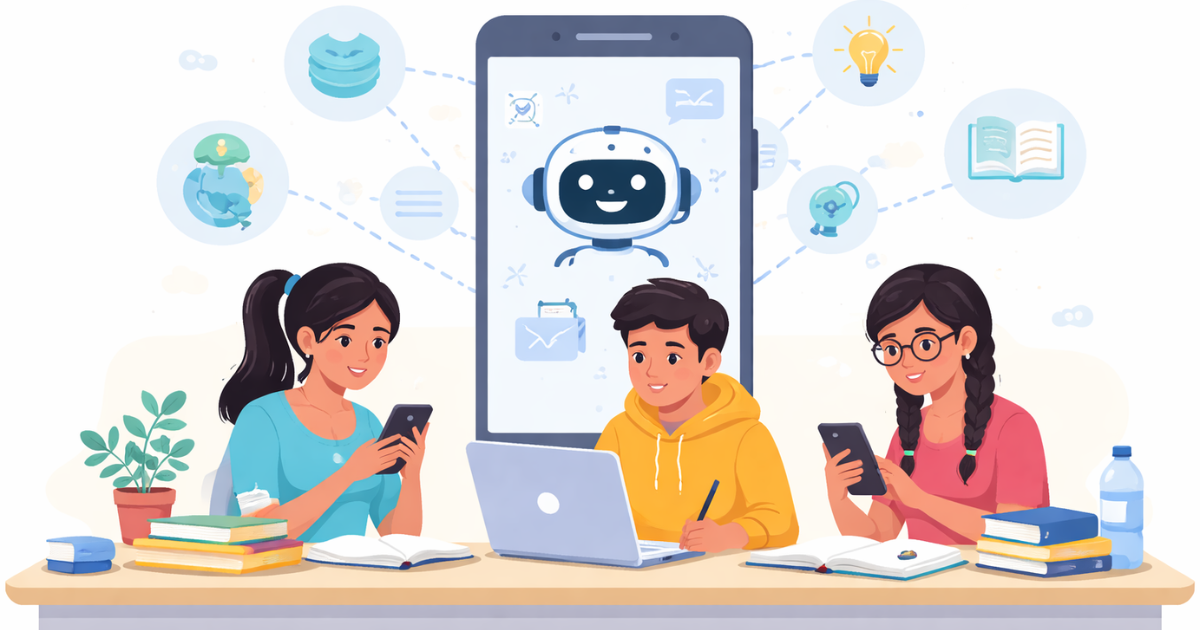
India’s education technology landscape in 2026 is being reshaped by a quieter but deeper shift than the headline-grabbing boom-and-bust cycles of earlier years. Artificial intelligence, once positioned as a futuristic add-on, is now becoming an everyday study companion for millions of Indian students. From school classrooms to competitive exam preparation and higher education, AI-driven learning apps are increasingly embedded in how students revise, practise, and clarify concepts, reflecting a change not just in tools, but in learning behaviour itself.
This transition is rooted in a simple reality: digital access is no longer the primary bottleneck. Smartphones and affordable data have become widespread across urban and semi-urban India, and familiarity with apps is nearly universal among teenagers. The challenge has shifted to how effectively these devices are used for learning rather than distraction. In 2026, AI-based education platforms are gaining adoption because they directly address this problem. They compress the time between confusion and understanding by offering instant explanations, adaptive practice, and feedback loops that feel personal, even at scale.
Unlike the first wave of Indian edtech, which was dominated by recorded video lectures and live online classes, the new generation of platforms is built around interaction. Students are no longer satisfied with passively watching content; they expect to ask questions in their own words, revisit mistakes immediately, and practise at a level that adjusts to their progress. AI-powered systems make this possible by analysing responses, identifying weak areas, and generating tailored exercises aligned to specific syllabi and exam patterns. For many learners, especially those preparing for board exams or competitive tests, this has turned short study sessions into focused, high-yield routines.
Crucially, the rise of AI learning apps does not signal a rejection of traditional teaching. Instead, it reflects the emergence of a hybrid model. Schools and coaching centres continue to provide structure, curriculum coverage, and high-stakes exam strategy, while AI tools fill in the gaps between classes. Late-night revision, last-minute doubt resolution, and targeted practice after mock tests are increasingly handled through apps that are available at any hour. For students who cannot afford personalised tutoring, these platforms offer a cost-effective approximation of one-to-one academic support.
Government-backed digital education initiatives have also played a role in normalising app-based learning. Over the past few years, national platforms and digital content repositories have familiarised students and teachers with structured online resources linked to textbooks and curricula. This has lowered resistance to newer AI-driven tools, which are now seen as an extension of existing digital learning habits rather than a radical departure. At the same time, state-level experiments and public discussions around artificial intelligence in education have pushed the concept into the mainstream, even as implementation quality varies widely.
Higher education institutions are another important driver of adoption in 2026. Colleges and universities are moving away from informal, unspoken use of AI tools toward clearer policies that define acceptable academic support. Many institutions are now using generative AI internally to create learning materials, design assessments, and offer adaptive tutoring, which in turn shapes student expectations. When universities themselves acknowledge AI as a legitimate learning aid, students are more likely to use similar tools responsibly for understanding concepts, practising problems, and organising their study schedules.
Student usage patterns across India reveal a practical, problem-solving orientation rather than blind dependence. AI apps are commonly used to simplify dense textbook language, often switching between English and regional languages. They are used to generate focused practice sets on specific topics, analyse mistakes after tests, and plan daily or weekly study targets during exam season. What drives continued engagement is not novelty, but efficiency: students stick with tools that save time and reduce frustration.
However, the rapid spread of AI-driven learning has also brought new concerns to the forefront. Accuracy remains a persistent challenge, particularly in complex or poorly framed questions where AI systems may produce confident but incorrect explanations. Data privacy is another growing issue, as minors interact with platforms that collect learning patterns and personal inputs. Academic integrity, especially in writing-intensive subjects, has become a central concern for educators who worry about the line between assistance and substitution of student effort.
These risks are shaping the next phase of platform design and institutional response. In 2026, responsible edtech companies are increasingly emphasising transparency, encouraging step-by-step reasoning, and positioning AI as a coach rather than an answer engine. Schools and colleges, meanwhile, are adapting assessment methods to reward understanding and process over final output, using in-class evaluations, oral checks, and iterative assignments to balance AI-assisted learning with genuine skill development.
For emerging edtech platforms, the stakes are high. India’s student population is vast and price-sensitive, leaving little room for products that rely solely on marketing claims. Success now depends on demonstrable learning outcomes, curriculum alignment, multilingual support, and trust. Platforms that treat artificial intelligence as a measurable learning engine, rather than a buzzword, are finding sustained adoption, while superficial implementations struggle to retain users.
By 2026, AI-driven learning apps are no longer reshaping Indian education through disruption alone, but through integration. They are becoming part of a layered learning ecosystem where technology augments teachers, reduces inequality in access to academic support, and helps students practise more effectively. The long-term impact will depend not on how advanced the algorithms become, but on how responsibly they are used to support understanding, curiosity, and independent thinking in one of the world’s largest education systems.
Disclaimer: The information presented in this article is intended for general informational purposes only. While every effort is made to ensure accuracy, completeness, and timeliness, data such as prices, market figures, government notifications, weather updates, holiday announcements, and public advisories are subject to change and may vary based on location and official revisions. Readers are strongly encouraged to verify details from relevant official sources before making financial, investment, career, travel, or personal decisions. This publication does not provide financial, investment, legal, or professional advice and shall not be held liable for any losses, damages, or actions taken in reliance on the information provided.
Last Updated on: Tuesday, February 10, 2026 9:41 am by News Proton Team | Published by: News Proton Team on Tuesday, February 10, 2026 9:41 am | News Categories: General, Education, Trending