
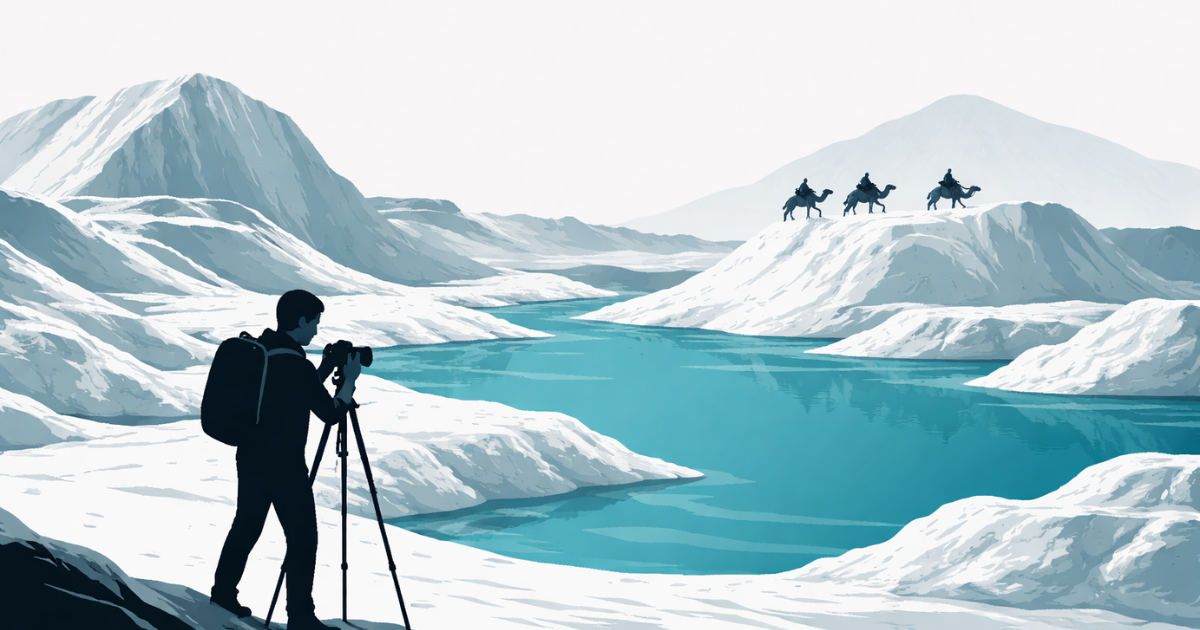
Rajasthan has long been defined by forts, palaces, deserts, and heritage cities, but a stark white landscape on the outskirts of Kishangarh has recently pushed the state into a very different kind of travel spotlight. Dubbed “Moonland” on social media, this surreal stretch of chalky mounds and pale blue water bodies has gone viral for looking nothing like the Rajasthan most travellers recognise. What appears online as a snowy plain or a lunar surface is, in reality, an industrial dumping site formed from marble slurry, yet it has rapidly emerged as one of India’s most talked-about unconventional travel locations.
The landscape lies in Kishangarh, a town in Ajmer district known as one of Asia’s largest marble-processing hubs. For decades, marble cutting and polishing units in the region have generated large volumes of slurry, a fine powdery waste mixed with water. This slurry has been deposited in designated dumping yards over time. Under Rajasthan’s intense sun, the water evaporates, leaving behind hardened layers of white sediment. Seen from a distance or through carefully framed videos, these formations resemble snowfields or cratered terrain, creating an illusion that has captivated online audiences.
The viral surge around “Moonland” has been driven largely by short-form video platforms. Creators filming at the site often highlight its stark colour palette and wide-open spaces, presenting it as “snow in Rajasthan” or a destination that feels more like Iceland or the moon than a desert state. The contrast between expectation and reality has been central to its appeal. In an era where travel discovery increasingly happens through social media feeds rather than guidebooks, the Kishangarh dumping yard has become a textbook example of how visual novelty can instantly transform an overlooked location into a headline-making destination.
Accessibility has played a crucial role in this rise. Kishangarh is well connected by road and rail and sits close to popular tourist routes linking Jaipur, Ajmer, and Pushkar. For travellers already exploring Rajasthan, the site requires little extra planning and no expensive permits or treks. This ease of access, combined with the promise of dramatic photographs, has made it particularly attractive for day-trippers, content creators, and photography enthusiasts looking for something different without leaving the state’s main travel corridor.
Another factor accelerating its popularity is the growing demand for “offbeat” destinations. Many domestic travellers are seeking locations that feel undiscovered or visually unusual, especially places that stand apart from well-documented tourist circuits. Kishangarh’s “Moonland” offers exactly that sensation. Its industrial origins, far from detracting from its appeal, have added to its mystique online. The setting feels raw, unconventional, and visually extreme, aligning perfectly with the internet’s appetite for destinations that challenge traditional ideas of beauty.
The site has also begun to fuel a small but noticeable photoshoot-driven economy. Visitors arrive not only to see the landscape but to stage elaborate shoots, including fashion photography and pre-wedding visuals. The dumping yard functions as an open-air set, its white terrain acting as a blank canvas that can be styled to resemble distant, exotic locations. This transformation from waste site to visual backdrop highlights how modern tourism is increasingly shaped by image creation rather than geography or heritage alone.
However, behind the striking visuals lies a more complex and uncomfortable reality. The “Moonland” is not a natural wonder, but a byproduct of industrial waste disposal. Environmental studies and regulatory discussions around marble slurry have long raised concerns about air quality, dust pollution, soil degradation, and potential risks to groundwater. Fine marble dust can become airborne, posing respiratory hazards, while accumulated slurry alters land cover and affects surrounding ecosystems. These issues have been part of official scrutiny and legal discussions well before the site became famous on social media.
The pools of milky blue water that appear in viral videos add another layer to this contradiction. While they enhance the site’s cinematic appeal, they are not natural lakes and are not meant for recreational use. The presence of standing water within an industrial waste area raises safety concerns, and authorities and observers have repeatedly cautioned against treating the site like a conventional tourist spot. The growing footfall has reignited debates around public safety, environmental responsibility, and the unintended consequences of viral travel trends.
The rise of Rajasthan’s “Moonland” reflects a broader shift in how destinations gain prominence in India today. Travel choices are increasingly influenced by what looks extraordinary on a smartphone screen, often without full context about environmental sensitivity or long-term sustainability. Places that photograph well and are easy to access can become overnight sensations, even if they were never designed to host visitors.
What happens next will determine whether Kishangarh’s viral fame remains a fleeting trend or becomes a more permanent chapter in Rajasthan’s tourism narrative. The challenge lies in balancing public curiosity with environmental management and safety. Without addressing the underlying waste issue, the site remains a visual illusion built on an industrial problem. Its popularity has forced a conversation about how virality can redefine landscapes and how quickly a dumping ground can be reimagined as a destination, even when the reality beneath the surface is far less glamorous.
For now, Rajasthan’s “Moonland” stands as a symbol of the internet age of travel, where perception often outruns context and where the most unusual destinations are sometimes not natural wonders, but the unexpected outcomes of human industry.
Disclaimer: The information presented in this article is intended for general informational purposes only. While every effort is made to ensure accuracy, completeness, and timeliness, data such as prices, market figures, government notifications, weather updates, holiday announcements, and public advisories are subject to change and may vary based on location and official revisions. Readers are strongly encouraged to verify details from relevant official sources before making financial, investment, career, travel, or personal decisions. This publication does not provide financial, investment, legal, or professional advice and shall not be held liable for any losses, damages, or actions taken in reliance on the information provided.
Last Updated on: Tuesday, February 10, 2026 10:11 am by News Proton Team | Published by: News Proton Team on Tuesday, February 10, 2026 10:11 am | News Categories: General, India, Travel