
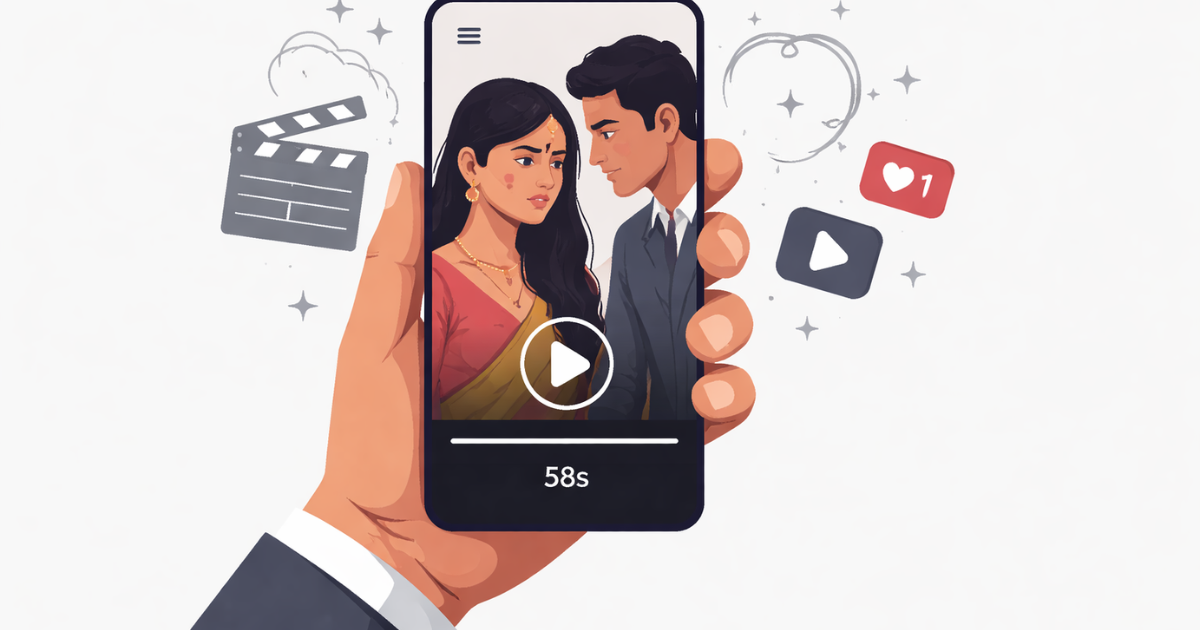
India’s digital entertainment landscape is undergoing a quiet but consequential shift. As audiences increasingly consume video on smartphones in short bursts throughout the day, a new storytelling format is gaining traction: the microdrama. Designed for vertical screens and built around episodes that often run for just one or two minutes, microdramas compress the emotional intensity of television serials and web series into ultra-short, highly serialized narratives. What began as an experiment on short-video platforms is now shaping up to be a distinct and fast-growing segment of India’s digital content economy.
The rise of microdramas is closely tied to how Indians use the internet today. With the country’s internet user base approaching the one-billion mark, mobile-first consumption has become the norm rather than the exception. Short-form video is now a daily habit for hundreds of millions of users, cutting across age groups, regions, and income levels. This behavioural shift has trained audiences to engage with content in frequent, brief sessions rather than long, uninterrupted viewing windows. Microdramas fit seamlessly into this pattern, offering cliffhanger-driven storytelling that rewards repeated check-ins rather than extended binge sessions.
Unlike traditional OTT series, which are produced primarily for horizontal screens and long-form viewing, microdramas are vertical-first by design. Episodes rely heavily on close-ups, fast-paced dialogue, and sharp emotional turns, often ending on dramatic hooks that push viewers to immediately watch the next instalment. The format borrows familiar narrative elements from Indian television soaps—romance, family conflict, moral dilemmas, and sudden reversals—but delivers them at a much faster tempo. This combination of cultural familiarity and modern packaging has helped microdramas gain quick acceptance among mainstream audiences.
On the supply side, the format has moved beyond user-generated experimentation to become a structured content category. Dedicated platforms and app sections have emerged to commission, produce, and distribute microdramas as a premium product. One notable example is KUKU TV, launched by audio storytelling platform KUKU FM, which focuses exclusively on vertical, serialized short dramas. These productions typically involve dozens of episodes per season, released at a rapid pace and optimized for habitual viewing rather than weekend binges.
The business logic behind microdramas differs significantly from that of mainstream OTT. While large streaming platforms invest heavily in a limited number of high-budget originals, microdrama platforms operate on lower production costs, faster turnaround times, and higher content volume. Monetization strategies often combine subscriptions, limited free access, and advertising or brand integrations. Instead of measuring success purely by total watch time, platforms track frequency, completion rates, and daily active engagement, aligning their economics with short-video consumption patterns.
Investment trends suggest growing confidence in this model. Over the past two years, funding into short-content and microdrama-focused platforms in India has increased sharply, reflecting expectations that the format can scale both in audience reach and revenue. App download numbers have also risen rapidly, indicating that microdramas are no longer a niche offering but part of mainstream digital entertainment consumption.
Creators have played a central role in this expansion. For actors, writers, and directors—particularly those working outside the Hindi and English mainstream—microdramas offer faster entry, creative visibility, and more frequent output than traditional television or OTT. The format is especially well-suited to India’s linguistic diversity, enabling platforms to commission stories in regional languages and dialects with relatively low risk. This regional adaptability strengthens microdramas’ appeal beyond metropolitan audiences and aligns with the broader shift toward vernacular digital content.
For established OTT platforms, the microdrama boom presents both a challenge and an opportunity. On one hand, short-form serialized content competes directly for user attention in a crowded digital environment. On the other, microdramas can function as testing grounds for new talent and story ideas that may later be expanded into longer-format series. As boundaries between short-video apps and OTT platforms continue to blur, hybrid strategies are likely to emerge, with vertical-first spin-offs, experimental short series, and cross-platform intellectual property becoming more common.
Advertising interest in microdramas is growing, but cautiously. Brands are attracted by the format’s immersive storytelling and the possibility of organic product integration within narrative contexts. At the same time, advertisers seek clearer measurement standards, brand safety assurances, and consistent audience data before committing large budgets. As platforms mature and analytics improve, advertising is expected to become a more significant revenue pillar for the sector.
Despite its momentum, the microdrama ecosystem faces challenges. Over-reliance on formulaic plots and exaggerated twists risks creative fatigue, while aggressive paywalls or opaque pricing could undermine user trust in a price-sensitive market. Content moderation and responsible storytelling are also critical, given the speed and scale at which episodes are produced and consumed.
Ultimately, the microdrama boom reflects a deeper transformation in India’s digital media economy. Attention is increasingly fragmented, mobile, and driven by habit rather than appointment viewing. Content is becoming modular and adaptable across formats, while regional language audiences are emerging as the primary growth engine. In this environment, microdramas are not merely a passing trend but a signal of how storytelling, technology, and business models are evolving together. Whether as standalone platforms or as extensions of larger OTT ecosystems, microdramas are redefining what entertainment looks like in a country where the smartphone has become the main screen.
Disclaimer: The information presented in this article is intended for general informational purposes only. While every effort is made to ensure accuracy, completeness, and timeliness, data such as prices, market figures, government notifications, weather updates, holiday announcements, and public advisories are subject to change and may vary based on location and official revisions. Readers are strongly encouraged to verify details from relevant official sources before making financial, investment, career, travel, or personal decisions. This publication does not provide financial, investment, legal, or professional advice and shall not be held liable for any losses, damages, or actions taken in reliance on the information provided.
Last Updated on: Tuesday, February 10, 2026 10:26 am by News Proton Team | Published by: News Proton Team on Tuesday, February 10, 2026 10:26 am | News Categories: General, Entertainment, Trending