
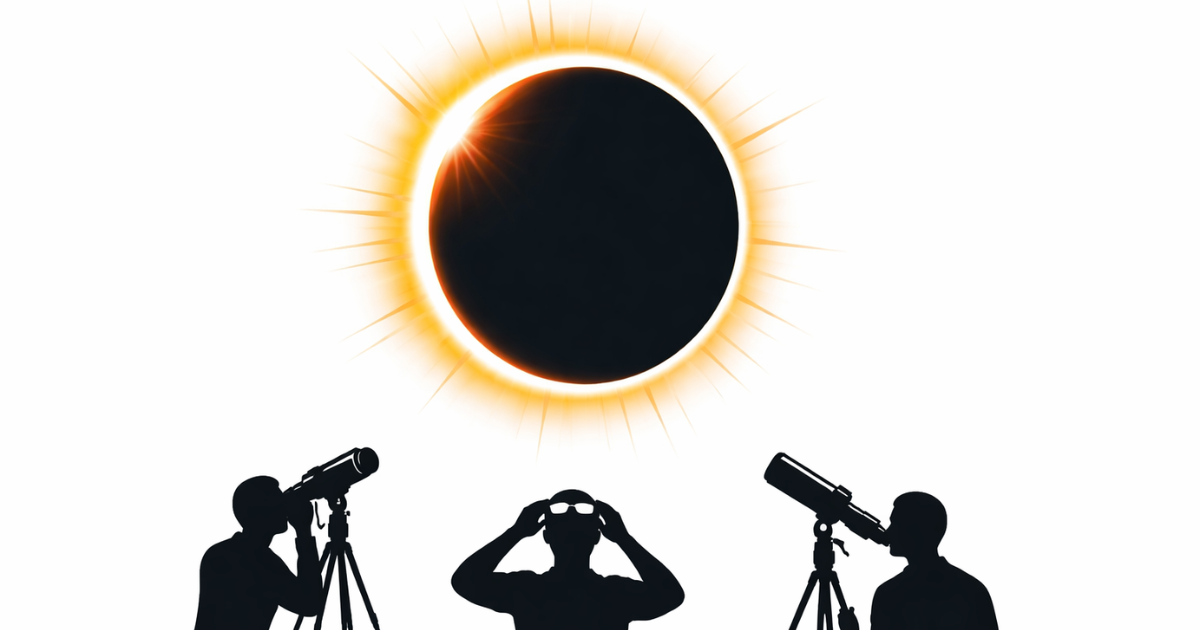
On February 17, 2026, skywatchers across parts of the Southern Hemisphere will witness one of the year’s most anticipated astronomical events: an annular solar eclipse, popularly known as a “Ring of Fire.” While the phrase often conjures dramatic images of a blazing solar halo visible to millions, this particular eclipse will be remarkable as much for where it is not seen as for where it is.
An annular solar eclipse occurs when the Moon passes directly between the Earth and the Sun but is too far from Earth in its orbit to completely cover the Sun’s disk. As a result, a thin ring of sunlight remains visible around the Moon’s silhouette at maximum alignment. Unlike a total solar eclipse, the sky does not turn dark, and the Sun’s outer atmosphere, or corona, is not visible. However, the visual effect of a bright ring suspended in the sky makes annular eclipses striking events in their own right.
According to astronomical calculations published by international space agencies and eclipse tracking authorities, the February 17, 2026 eclipse will reach its annular phase over Antarctica. The central path of annularity — the narrow corridor where the full “Ring of Fire” effect is visible — lies almost entirely across the Antarctic continent and surrounding ocean regions. This means that only a limited number of observers, primarily scientists and personnel stationed at Antarctic research facilities, will have the opportunity to witness the complete ring effect directly.
Outside the central path, a partial solar eclipse will be visible across parts of southern Africa, the southernmost regions of South America, and several areas over the Pacific, Atlantic, and Indian Oceans. In countries such as South Africa, Namibia, Botswana, Zimbabwe, Mozambique, Chile, and Argentina, observers will see the Moon take a noticeable “bite” out of the Sun, though it will not form a full ring. The exact magnitude of the eclipse will vary by location, depending on geographic coordinates and local timing.
Large parts of the world — including India, most of Europe, North America, and East Asia — will not see the eclipse at all. For those regions, interest in the event will largely unfold through scientific coverage, satellite imagery, and global media updates rather than direct observation.
Despite its limited visibility, the 2026 annular eclipse has generated strong interest within the global scientific community. Solar eclipses offer rare opportunities to study solar radiation changes, atmospheric responses, and subtle shifts in temperature and wind patterns during the temporary reduction of sunlight. Although annular eclipses do not allow observation of the solar corona as total eclipses do, they still provide valuable data for researchers studying solar dynamics and Earth’s atmospheric behavior.
In southern Africa, where the eclipse will be partially visible, astronomy institutions and science outreach organizations have emphasized public engagement alongside safety awareness. Experts continue to stress that looking directly at the Sun without proper protection can cause serious and permanent eye damage. Unlike total eclipses, during which there is a brief safe window to view totality with the naked eye, annular eclipses never provide a moment when the Sun is completely covered. Certified solar viewing glasses or properly filtered telescopes and binoculars are essential throughout the entire event.
Globally, public reactions reflect a mix of curiosity and anticipation, tempered by the reality that this eclipse will not be a mass tourism spectacle. In recent years, total solar eclipses have drawn millions of travelers into the path of totality, boosting local economies and creating large public gatherings. By contrast, the 2026 “Ring of Fire” will be experienced more quietly, largely through scientific stations in Antarctica and localized viewing events in southern Africa and parts of South America.
The timing of the eclipse, based on coordinated universal time, places its maximum phase around midday in Antarctica, with the entire event lasting several hours from first partial contact to final separation. Because the annular phase is geographically remote, much of the world will follow the event through updates from observatories and space agencies rather than through large-scale live broadcasts.
The February event is also notable because it is the first of two solar eclipses in 2026. Later in the year, on August 12, 2026, a total solar eclipse will occur along a different path, expected to draw significantly broader global attention due to its accessibility and the dramatic nature of totality. As a result, many eclipse enthusiasts see February’s event as a scientific milestone and a precursor to a more widely visible spectacle later in the year.
Astronomers note that eclipses, whether total or annular, are part of predictable celestial cycles governed by the geometry of the Sun, Earth, and Moon. Yet each one carries a sense of rarity because of its limited geographic footprint. The 2026 annular eclipse is a reminder of how vast and varied our planet is: while one region experiences a luminous ring in the Antarctic sky, much of the world continues its routine day unaware of the cosmic alignment taking place.
In the end, global reactions to the February 17 “Ring of Fire” eclipse reflect both the power and the limits of modern connectivity. Even when an event unfolds in one of the most remote places on Earth, scientific collaboration and digital communication ensure that it becomes a shared moment of curiosity. Though few will stand beneath the Antarctic Sun to see the glowing ring in person, the eclipse will still reinforce a timeless truth — that celestial events continue to captivate humanity, wherever they are visible.
Add newsproton.com as preferred source on google – Click here
Disclaimer: The information presented in this article is intended for general informational purposes only. While every effort is made to ensure accuracy, completeness, and timeliness, data such as prices, market figures, government notifications, weather updates, holiday announcements, and public advisories are subject to change and may vary based on location and official revisions. Readers are strongly encouraged to verify details from relevant official sources before making financial, investment, career, travel, or personal decisions. This publication does not provide financial, investment, legal, or professional advice and shall not be held liable for any losses, damages, or actions taken in reliance on the information provided.
Last Updated on: Tuesday, February 17, 2026 10:30 am by News Proton Team | Published by: News Proton Team on Tuesday, February 17, 2026 10:30 am | News Categories: General