
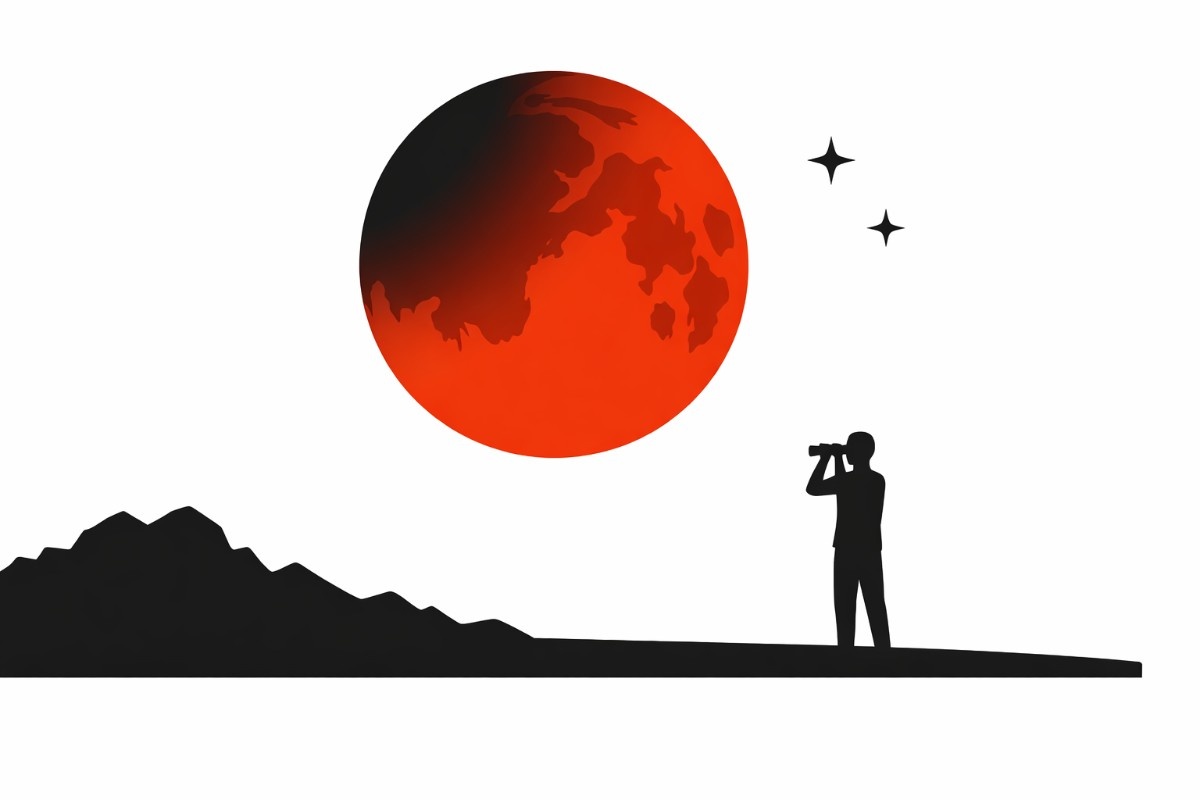
Holi 2026 will bring more than colour and celebration. On March 3, 2026, the full moon of Phalguna will coincide with a total lunar eclipse — a celestial event that can turn the Moon a deep copper-red, often referred to as a “Blood Moon.” The rare overlap of a major Indian festival and a total lunar eclipse has generated significant interest among skywatchers and festival-goers alike.
A total lunar eclipse occurs when the Earth moves directly between the Sun and the Moon, casting its shadow across the lunar surface. During totality, the Moon does not disappear completely. Instead, sunlight filtered through Earth’s atmosphere bends and scatters, allowing red wavelengths to reach the Moon while shorter blue wavelengths are filtered out. This atmospheric filtering effect gives the eclipsed Moon its distinctive reddish hue.
According to astronomical projections for March 3, 2026, the eclipse will unfold during the late afternoon and early evening hours in India. The partial phase is expected to begin in the mid-afternoon, followed by totality later in the evening. However, visibility across India will vary significantly depending on local moonrise times. In several parts of the country, especially western and central regions, the Moon will rise after totality has already begun or even concluded. As a result, many cities may only witness the concluding phases of the eclipse rather than the full “Blood Moon” at its peak.
Eastern and northeastern parts of India are expected to offer the best viewing opportunities. Cities such as Guwahati, Imphal, Agartala and Aizawl are likely to experience earlier moonrise times, increasing the chances of seeing at least the final moments of totality before the Moon gradually emerges from Earth’s shadow. Even in these locations, the eclipsed Moon may initially appear faint and low on the horizon, requiring a clear, unobstructed eastern view for optimal visibility.
In contrast, major metropolitan centres including Delhi, Mumbai, Hyderabad and Bengaluru may see only the later stages of the eclipse. In these cities, the Moon will rise close to or after the end of totality, meaning observers are more likely to witness a partially eclipsed Moon rather than the deep red phase. Kolkata may have slightly better timing compared to western cities, but totality could still end before the Moon becomes clearly visible above the horizon.
Astronomers note that lunar eclipses are completely safe to observe with the naked eye. Unlike solar eclipses, no protective eyewear is required. The best way to experience the event is to choose an open location with a clear view toward the eastern horizon. Rooftops, beaches, riverbanks and open grounds generally provide better sightlines than densely built urban streets.
The March 2026 eclipse is part of a broader cycle of lunar eclipses that occur periodically when the Sun, Earth and Moon align precisely during a full moon. While lunar eclipses are not extremely rare globally, the coincidence with Holi makes this event particularly special for observers in India. Holi itself is tied to the lunar calendar, celebrated on the full moon day of Phalguna, which explains the alignment with a lunar eclipse.
The visual impact of a “Blood Moon” can vary depending on atmospheric conditions. Dust, pollution, or volcanic particles in Earth’s atmosphere can deepen the red coloration, sometimes giving the Moon a darker, almost rust-coloured appearance. Clear skies will be crucial for viewers hoping to witness the phenomenon, especially in regions where the eclipse will be visible only briefly near moonrise.
For many Indians, the 2026 Holi eclipse will be a fleeting yet memorable spectacle — a moment when tradition and astronomy intersect. As colours fill the air during the festival, the evening sky may offer its own dramatic display, reminding observers of the intricate celestial mechanics that govern the lunar calendar and shape the timing of cultural celebrations.
While not all regions will experience the full red glow at its peak, the event still presents a rare opportunity to observe a significant astronomical occurrence on a major festival day. Weather permitting, the Holi 2026 lunar eclipse is expected to be one of the most talked-about sky events of the year, blending science, culture and spectacle into a single evening horizon.
Disclaimer: The information presented in this article is intended for general informational purposes only. While every effort is made to ensure accuracy, completeness, and timeliness, data such as prices, market figures, government notifications, weather updates, holiday announcements, and public advisories are subject to change and may vary based on location and official revisions. Readers are strongly encouraged to verify details from relevant official sources before making financial, investment, career, travel, or personal decisions. This publication does not provide financial, investment, legal, or professional advice and shall not be held liable for any losses, damages, or actions taken in reliance on the information provided.
Edited by Madhusudhan Reddy
Last Updated on: Tuesday, March 3, 2026 12:30 pm by News Proton Team | Published by: News Proton Team on Tuesday, March 3, 2026 12:29 pm | News Categories: News, General