
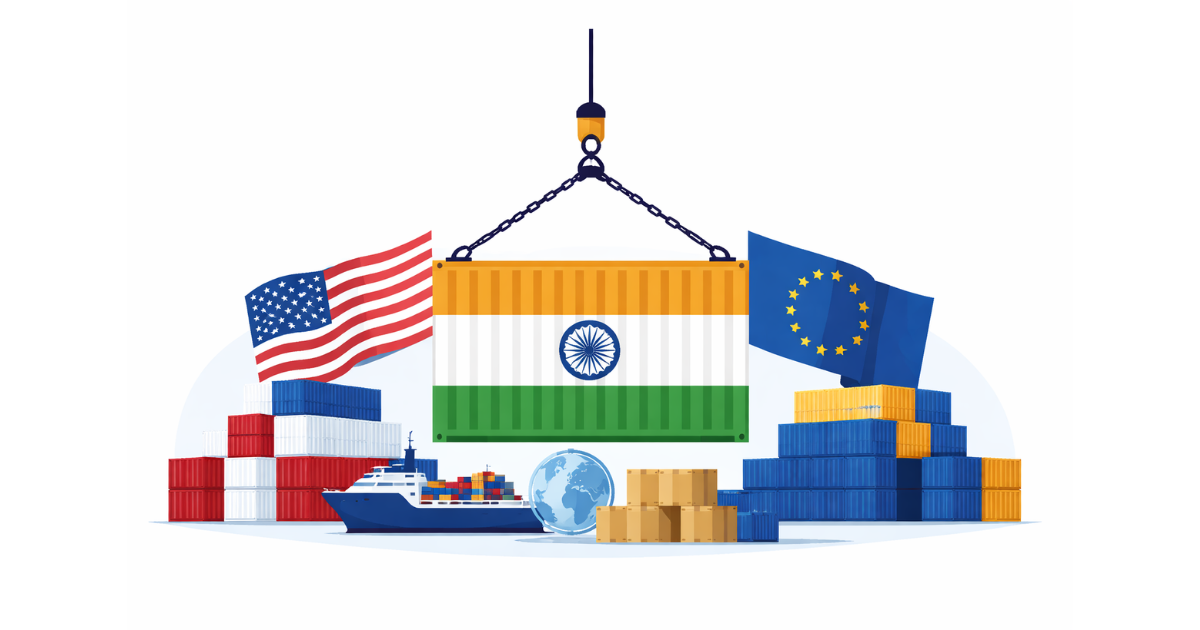
India’s trade strategy is undergoing a structural shift as New Delhi deepens economic engagement with the United States and the European Union, two of its largest and most influential trading partners. The recent momentum in negotiations with Washington and the conclusion of a long-pending free trade agreement with Brussels signal more than incremental tariff adjustments. They reflect a broader realignment of India’s external economic policy at a time when global supply chains are being reconfigured amid geopolitical tensions, industrial policy shifts and sustainability-driven trade rules.
The United States remains India’s largest trading partner. According to official US trade data, total bilateral goods and services trade crossed $200 billion in 2024, underscoring the depth of the economic relationship. Goods trade accounts for a significant portion, with India exporting pharmaceuticals, engineering goods, textiles, gems and jewellery, and chemicals, while importing energy products, aircraft components, and advanced technology goods. Services trade, particularly in information technology and business services, also represents a substantial and growing segment of the partnership.
Recent high-level statements from both governments have indicated progress toward a structured trade arrangement aimed at recalibrating tariffs and addressing longstanding market access concerns. While not yet a full-fledged free trade agreement, the evolving framework is designed to reduce friction in key sectors and provide greater predictability to exporters. For Indian industry, even marginal tariff stability in labour-intensive sectors such as textiles, leather and certain manufactured goods can have measurable effects on pricing competitiveness in the US market.
However, the US track is not without complexity. Trade discussions increasingly intersect with issues such as digital taxation, agricultural market access, and regulatory transparency. Reports indicate that discussions have included the digital services tax and tariff adjustments on selected industrial and agricultural items. These areas are politically sensitive within India, particularly agriculture, which remains a livelihood backbone for millions. Any perceived increase in import competition must be balanced against domestic policy priorities and rural income concerns.
Parallel to the US engagement, India and the European Union concluded negotiations on a comprehensive Free Trade Agreement in early 2026 after nearly two decades of intermittent talks. The EU is among India’s largest trading partners, with bilateral goods trade exceeding €120 billion in recent years and services trade adding tens of billions more. The agreement is expected to reduce tariffs on a wide range of goods and establish clearer frameworks for services, investment and regulatory cooperation.
For Indian exporters, improved access to the EU market presents opportunities in engineering goods, automotive components, pharmaceuticals, chemicals, textiles and processed agricultural products. The EU market is large, relatively high-income and standards-driven. Securing predictable access can help Indian firms scale operations and integrate further into European supply chains.
Yet the EU relationship also presents one of the most significant adjustment challenges. Europe’s trade policy is increasingly shaped by sustainability, climate and due diligence frameworks. The Carbon Border Adjustment Mechanism, which enters its definitive phase in 2026, will require importers of certain carbon-intensive goods to account for embedded emissions. Although the legal obligation lies with EU importers, the burden of emissions data and compliance effectively extends to producers in exporting countries. Indian sectors such as steel, aluminium and cement will need robust carbon accounting systems to remain competitive.
This shift marks a departure from traditional tariff-centric trade diplomacy. Market access is now intertwined with environmental compliance, supply chain traceability and technical standards. For Indian exporters, especially small and medium enterprises, meeting these requirements demands investment in technology, certification and reporting infrastructure. Larger firms may adapt more easily, but smaller players risk being marginalised unless supported by domestic policy measures and institutional capacity building.
The strategic dimension of India’s trade engagements is equally important. Both the US and EU view India as a key partner in diversifying supply chains away from overdependence on single geographies. India, in turn, seeks to position itself as a reliable manufacturing and services hub. Initiatives such as production-linked incentive schemes and infrastructure upgrades are intended to strengthen domestic manufacturing competitiveness so that trade agreements translate into tangible export growth rather than simply increased imports.
At the same time, India must manage competitive pressures from other exporting nations that are negotiating their own trade arrangements with advanced economies. Preferential access is rarely exclusive. If competitor countries secure similar or more favourable tariff terms, India’s relative advantage could narrow. This dynamic is particularly visible in labour-intensive exports like textiles, where small differences in tariff rates can shift sourcing decisions among global buyers.
Agriculture remains the most politically delicate component of any trade arrangement. Both the US and EU have strong agricultural export interests, while India maintains protective measures in certain farm categories to shield domestic producers. Reconciling these interests requires careful calibration, phased adjustments and safeguards that protect vulnerable segments without undermining broader economic objectives.
The broader economic gains from India’s strategic trade engagements are plausible but conditional. Reduced tariffs and enhanced market access can support export growth, attract foreign direct investment and integrate Indian firms into global value chains. The services sector, especially information technology and professional services, may benefit from clearer regulatory pathways and improved recognition frameworks.
Yet the success of these engagements will depend on implementation. Trade agreements generate opportunity, but real economic gains require domestic readiness. This includes standards infrastructure, customs efficiency, digital compliance systems and support mechanisms for smaller exporters. Without these complementary reforms, preferential market access may disproportionately benefit larger corporations with existing compliance capacity.
India’s evolving trade diplomacy reflects a pragmatic balancing act. The country seeks deeper integration with advanced markets while preserving policy space for development objectives. In a global environment marked by economic fragmentation and strategic competition, aligning with both the US and the EU strengthens India’s economic resilience and geopolitical positioning.
The coming years will reveal whether these agreements translate into durable export expansion and sectoral transformation. For now, India’s strategic trade engagements represent a calculated move to leverage shifting global dynamics. The economic gains are within reach, but the challenges—regulatory, political and structural—are substantial and will require sustained policy coordination and industry adaptation.
Disclaimer: The information presented in this article is intended for general informational purposes only. While every effort is made to ensure accuracy, completeness, and timeliness, data such as prices, market figures, government notifications, weather updates, holiday announcements, and public advisories are subject to change and may vary based on location and official revisions. Readers are strongly encouraged to verify details from relevant official sources before making financial, investment, career, travel, or personal decisions. This publication does not provide financial, investment, legal, or professional advice and shall not be held liable for any losses, damages, or actions taken in reliance on the information provided.
Last Updated on: Wednesday, February 11, 2026 11:50 am by News Proton Team | Published by: News Proton Team on Wednesday, February 11, 2026 11:50 am | News Categories: Politics, General, India