
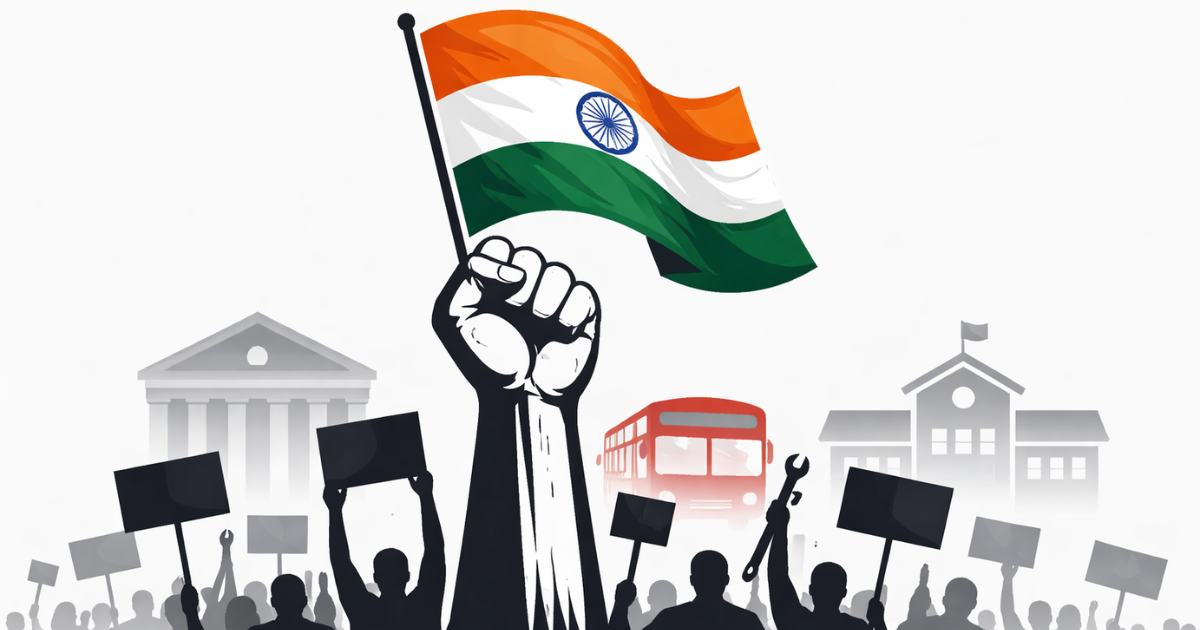
A nationwide Bharat Bandh called by central trade unions and supported by several farmers’ organisations has led to disruptions in parts of India today, affecting banking operations, public transport services and attendance in government offices. While essential services remain operational, the extent of the shutdown varies from state to state depending on participation levels and local administrative responses.
The strike has been organised by multiple central trade union federations protesting against labour reforms, employment conditions and trade-related concerns. Union leaders have reiterated their opposition to the four labour codes implemented by the Centre, arguing that the new framework weakens worker protections and collective bargaining rights. Farmers’ groups supporting the bandh have also raised concerns over agricultural policies and trade agreements, claiming that these measures could adversely affect domestic producers. Organisers have stated that a large number of workers across sectors, including banking, insurance, coal, transport and state-run enterprises, are participating in the strike.
Banking services have been among the most closely watched sectors today. There is no official holiday declared by the Reserve Bank of India for February 12, meaning banks are scheduled to remain open. However, employee unions in several public sector banks have extended support to the strike, leading to possible staff shortages in branches. As a result, customers in some cities have reported delays in counter services such as cash withdrawals, deposits and cheque clearances. Digital banking platforms, ATMs and online payment systems are functioning normally, ensuring that electronic transactions remain unaffected.
Transport services have experienced uneven disruptions. In several states, sections of state-run bus services and local public transport have operated with reduced frequency due to participation by transport unions. Major railway services and domestic flights continue to operate as per schedule, though commuters in certain areas have faced difficulties reaching stations and airports because of localised protests and road blockades. Authorities have deployed additional security personnel in sensitive areas to maintain public order and facilitate the movement of essential services.
Schools and educational institutions are largely functioning as usual across most states, as no nationwide closure order has been issued. However, attendance in some institutions has been lower than normal due to transportation challenges and precautionary decisions by parents. In districts witnessing stronger protest activity, local administrations and school managements have taken independent calls regarding temporary suspension of classes or shortened schedules. Universities and colleges have also reported mixed attendance depending on the intensity of bandh participation in their respective regions.
Government offices in several states have recorded lower attendance, particularly where employee unions are actively involved in the strike. Despite this, administrative functions are continuing, and officials have stated that critical public services remain operational. Hospitals, emergency services, fire departments and law enforcement agencies are functioning without interruption, as these sectors are exempt from the strike.
The Union government has acknowledged the right to protest while emphasising the need to adhere to established legal procedures governing industrial action. Officials have urged citizens to remain calm and rely on verified updates from state authorities. State governments have issued advisories to ensure the smooth supply of essential commodities and prevent any disruption to healthcare and emergency response systems.
Economic analysts note that nationwide strikes of this scale highlight ongoing tensions between organised labour groups and policymakers over structural reforms. While the long-term economic impact of a one-day bandh is generally limited, disruptions in banking operations, transport and commercial activity can affect daily wage earners and small businesses in the short term. Market activity in financial exchanges is continuing as scheduled, though sector-specific participation by employees may influence back-end operations.
As the day progresses, the overall impact of the Bharat Bandh remains region-specific. In metropolitan areas, commercial establishments are largely open, though some markets have witnessed partial closures. In industrial belts and union-strong regions, participation appears more pronounced. Authorities continue to monitor developments to ensure law and order is maintained.
For citizens, the primary advisory remains to check local updates before planning travel or visiting public offices. While core services are operational across much of the country, on-ground conditions differ by state and district. The Bharat Bandh of February 12, 2026 thus reflects a significant moment of coordinated protest, with its impact shaped by local participation levels and administrative preparedness.
Disclaimer: The information presented in this article is intended for general informational purposes only. While every effort is made to ensure accuracy, completeness, and timeliness, data such as prices, market figures, government notifications, weather updates, holiday announcements, and public advisories are subject to change and may vary based on location and official revisions. Readers are strongly encouraged to verify details from relevant official sources before making financial, investment, career, travel, or personal decisions. This publication does not provide financial, investment, legal, or professional advice and shall not be held liable for any losses, damages, or actions taken in reliance on the information provided.
Also Read : https://newsproton.com/auto-sales-report-january-2026-which-brands-led-indias-passenger-vehicle-market/
Add newsproton.com as preferred source on google – Click here
Last Updated on: Thursday, February 12, 2026 10:15 am by News Proton Team | Published by: News Proton Team on Thursday, February 12, 2026 10:15 am | News Categories: India