


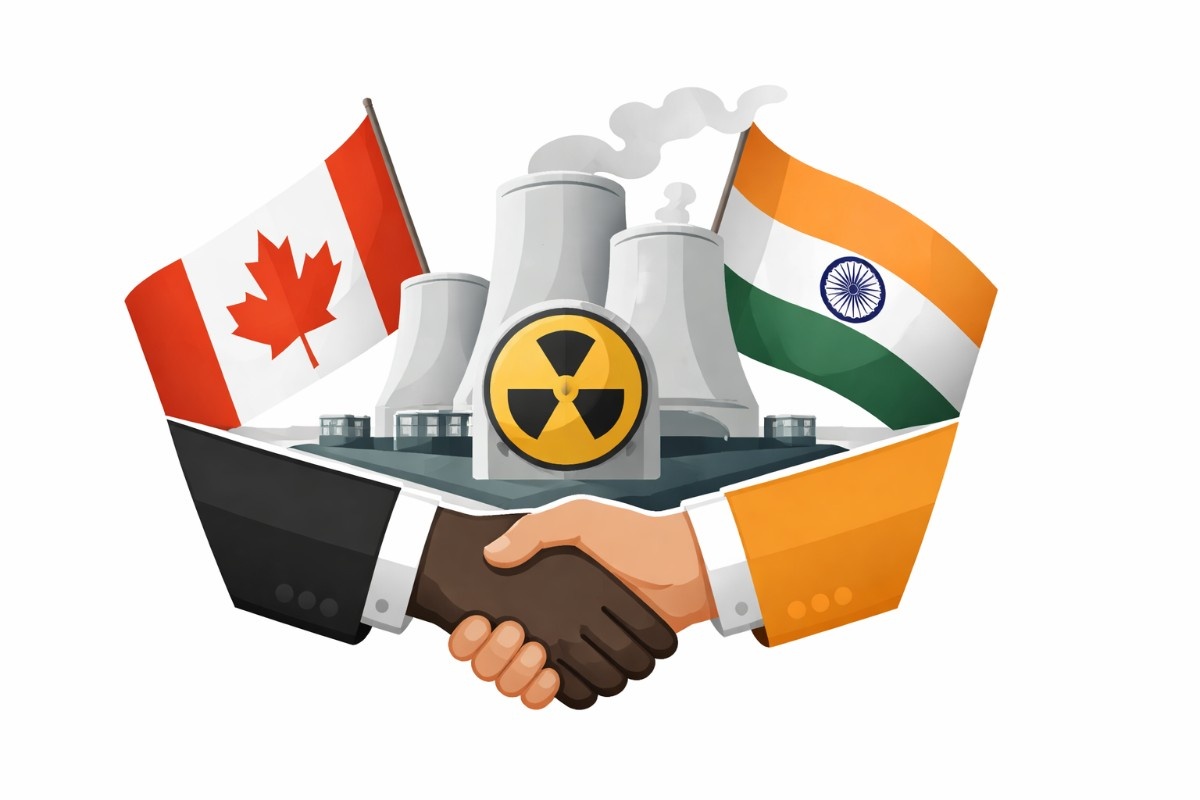


India and Canada have announced a major civil nuclear energy partnership that both governments describe as a decisive step toward strengthening economic growth, clean energy cooperation and long-term strategic stability. The agreement, finalised during the recent high-level engagements between Prime Minister Narendra Modi and Canadian Prime Minister Mark Carney, marks one of the most significant developments in bilateral ties in recent years.
At the centre of the partnership is a long-term uranium supply agreement between Canadian uranium producer Cameco and India’s Department of Atomic Energy. Under the agreement, Canada will supply nearly 22 million pounds of uranium ore concentrate to India over an eight-year period from 2027 to 2035. The contract, valued at approximately C$2.6 billion, is structured on market-based pricing terms and is expected to provide predictable fuel supply for India’s expanding nuclear power programme.
For India, the deal strengthens energy security at a time when electricity demand continues to rise alongside rapid industrial growth and urbanisation. Nuclear energy forms an important part of India’s strategy to diversify its energy mix while reducing dependence on fossil fuels. With ambitious climate targets and increasing pressure to transition toward low-carbon sources, reliable uranium imports are critical to sustaining and scaling reactor operations.
Canada, one of the world’s leading uranium producers, views the agreement as both a commercial and strategic opportunity. The deal secures a large, stable export market for its nuclear fuel industry and reinforces Canada’s position as a trusted supplier within the global civil nuclear framework. Officials on both sides emphasised that the agreement operates fully within established international safeguards and peaceful-use commitments.
The foundation for this cooperation dates back to the civil Nuclear Cooperation Agreement signed between the two countries in 2010 and brought into force in 2013. That framework enabled uranium trade for civilian purposes under strict regulatory oversight. The new supply contract builds upon that structure, reflecting renewed confidence and political will to deepen engagement.
Beyond uranium supply, both governments signalled intent to collaborate in advanced nuclear technologies, including small modular reactors. Such technologies are increasingly seen as flexible, scalable solutions that can complement large nuclear plants and integrate more effectively with renewable energy grids. While detailed project announcements are yet to be made, the strategic intent suggests a broader technological partnership rather than a simple commodity transaction.
The timing of the agreement carries diplomatic significance. Relations between India and Canada experienced a period of strain in recent years, leading to a slowdown in high-level engagements. The latest visit and the announcements that followed are widely interpreted as part of a structured reset aimed at restoring momentum in economic and strategic cooperation. Nuclear energy, given its long-term and high-trust nature, often serves as a stabilising pillar in such resets.
Economic implications extend beyond the nuclear sector. Leaders from both sides have expressed ambitions to significantly increase bilateral trade and work toward concluding a broader economic partnership agreement. Energy cooperation, especially one involving multi-billion-dollar long-term contracts, sends a strong signal to investors and industry stakeholders that both governments are prepared to pursue pragmatic, forward-looking collaboration.
From a security perspective, the partnership strengthens India’s ability to ensure steady fuel supply for civilian nuclear reactors, reducing vulnerability to global supply disruptions. For Canada, it reinforces its credibility as a reliable energy partner within the Indo-Pacific region. Importantly, all cooperation remains confined to peaceful civilian applications under established monitoring mechanisms.
As the agreement moves toward implementation beginning in 2027, attention will shift to logistics, regulatory coordination and potential expansion into advanced reactor research. If successfully executed, the partnership could become a cornerstone of a broader India–Canada strategic alignment focused on clean energy, trade growth and long-term geopolitical stability.
In a global landscape shaped by energy transition pressures and shifting alliances, the India–Canada nuclear partnership stands out as a calculated and mutually beneficial move — one that blends economic pragmatism with strategic foresight.
Disclaimer: The information presented in this article is intended for general informational purposes only. While every effort is made to ensure accuracy, completeness, and timeliness, data such as prices, market figures, government notifications, weather updates, holiday announcements, and public advisories are subject to change and may vary based on location and official revisions. Readers are strongly encouraged to verify details from relevant official sources before making financial, investment, career, travel, or personal decisions. This publication does not provide financial, investment, legal, or professional advice and shall not be held liable for any losses, damages, or actions taken in reliance on the information provided.
Edited by Madhusudhan Reddy
Last Updated on: Tuesday, March 3, 2026 12:16 pm by News Proton Team | Published by: News Proton Team on Tuesday, March 3, 2026 12:16 pm | News Categories: Interview