
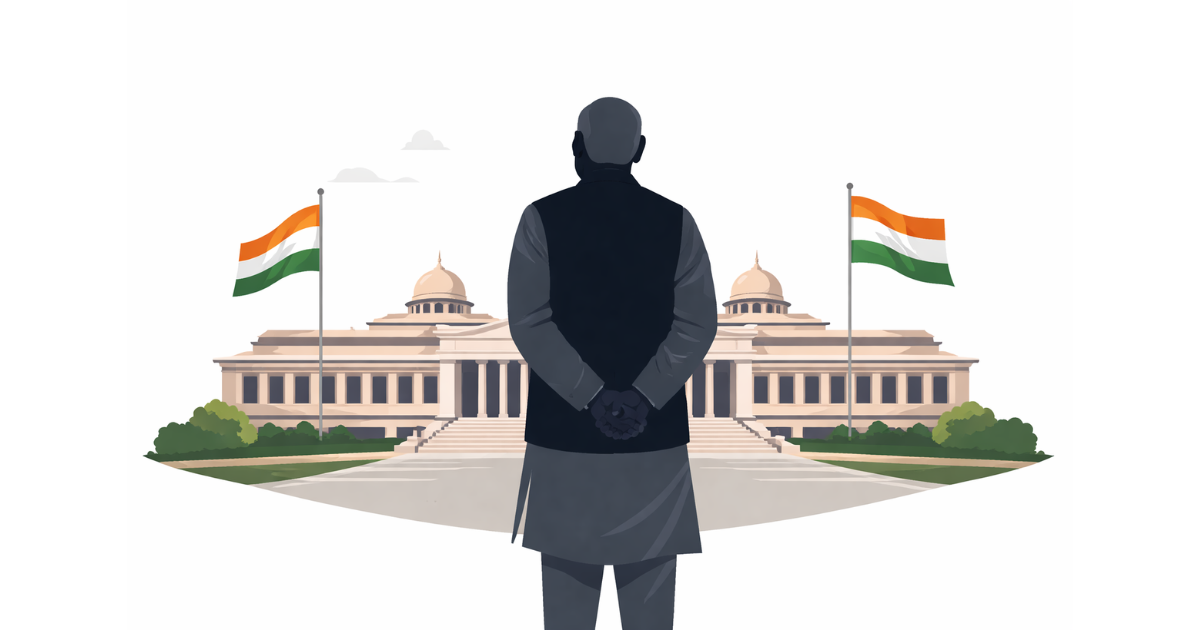
Prime Minister Narendra Modi has formally shifted his official office from South Block to a newly constructed complex named Seva Teerth, marking a significant moment in the evolution of India’s administrative infrastructure. The move is part of the broader Central Vista redevelopment initiative and represents both a physical relocation and a symbolic repositioning of how the government defines its institutional identity.
For nearly eight decades, the Prime Minister’s Office functioned out of South Block, one of the most recognisable colonial-era buildings in the national capital. Since Independence in 1947, South Block has housed the highest levels of executive authority, becoming synonymous with the country’s decision-making apparatus. The relocation ends that long chapter and ushers in a new phase in which the executive branch operates from a purpose-built, modern administrative campus.
The name “Seva Teerth” carries deliberate meaning. In Hindi, “seva” refers to service and “teerth” denotes a sacred place or pilgrimage site. Government statements have described the naming as an expression of the administration’s emphasis on public service and citizen-centric governance. The shift is intended to underscore the idea that public office is fundamentally about service rather than authority. Officials have positioned the move as consistent with a broader effort to reframe governance institutions around accessibility, accountability and efficiency.
The new campus comprises multiple interconnected buildings designed to house the Prime Minister’s Office, the Cabinet Secretariat and the National Security Council Secretariat in close proximity. Previously, these key arms of governance operated from separate locations. By bringing them together within a single integrated complex, the government aims to streamline coordination among top decision-making bodies and reduce administrative delays. In modern governance, where rapid response is critical during crises, policy roll-outs or international negotiations, proximity and integrated infrastructure can significantly influence efficiency.
Unlike South Block, which was retrofitted over the decades to accommodate modern technological requirements, Seva Teerth has been designed with contemporary administrative needs in mind. The complex is equipped with upgraded communication systems, advanced security architecture and infrastructure tailored to digital governance. As policymaking increasingly relies on secure data networks, real-time information exchange and integrated monitoring systems, such facilities are seen as necessary to support effective governance in a digital era.
The relocation is also closely tied to the transformation of the Central Vista corridor. As part of the redevelopment plan, the historic North and South Block buildings are slated to be repurposed into a national museum complex, reflecting India’s civilisational and institutional journey. This change signals a broader effort to reinterpret colonial-era architecture within a democratic and public-facing framework. Rather than continuing to function as administrative hubs, the heritage buildings will now serve as spaces for public engagement with the nation’s history.
Supporters of the move argue that modern administrative infrastructure can improve workflow, enhance inter-ministerial collaboration and enable quicker implementation of public programmes. They point out that governance today involves complex coordination across sectors ranging from national security and economic management to digital policy and disaster response. A consolidated, technology-ready campus may therefore strengthen institutional efficiency.
At the same time, the shift is being viewed through a symbolic lens. Naming the Prime Minister’s office complex Seva Teerth reflects the government’s attempt to embed the concept of service into the physical identity of the executive branch. Whether such symbolism translates into measurable improvements in public service delivery will depend on policy execution, administrative transparency and responsiveness to citizens’ needs.
The relocation does not in itself alter constitutional structures or administrative hierarchies. The functions of the Prime Minister’s Office remain the same, including policy coordination, strategic planning and oversight of government initiatives. What changes is the physical environment in which these responsibilities are carried out. In governance, infrastructure often shapes institutional culture, influencing workflow patterns and internal collaboration.
For India, the shift from South Block to Seva Teerth marks a moment of transition that blends continuity with change. The executive authority remains intact, but its spatial and symbolic setting has evolved. As the government settles into its new premises, attention will increasingly focus on whether the promised gains in coordination and efficiency translate into tangible improvements in governance and public services.
The move stands as one of the most visible administrative transformations in recent years, reflecting a broader ambition to modernise state infrastructure while redefining its public narrative around service. In the years ahead, the impact of Seva Teerth will ultimately be assessed not by architecture alone, but by the effectiveness with which governance outcomes reach the citizens it is meant to serve.
Disclaimer: The information presented in this article is intended for general informational purposes only. While every effort is made to ensure accuracy, completeness, and timeliness, data such as prices, market figures, government notifications, weather updates, holiday announcements, and public advisories are subject to change and may vary based on location and official revisions. Readers are strongly encouraged to verify details from relevant official sources before making financial, investment, career, travel, or personal decisions. This publication does not provide financial, investment, legal, or professional advice and shall not be held liable for any losses, damages, or actions taken in reliance on the information provided.
Add newsproton.com as preferred source on google – Click here
Last Updated on: Thursday, February 12, 2026 10:25 am by News Proton Team | Published by: News Proton Team on Thursday, February 12, 2026 10:25 am | News Categories: India