
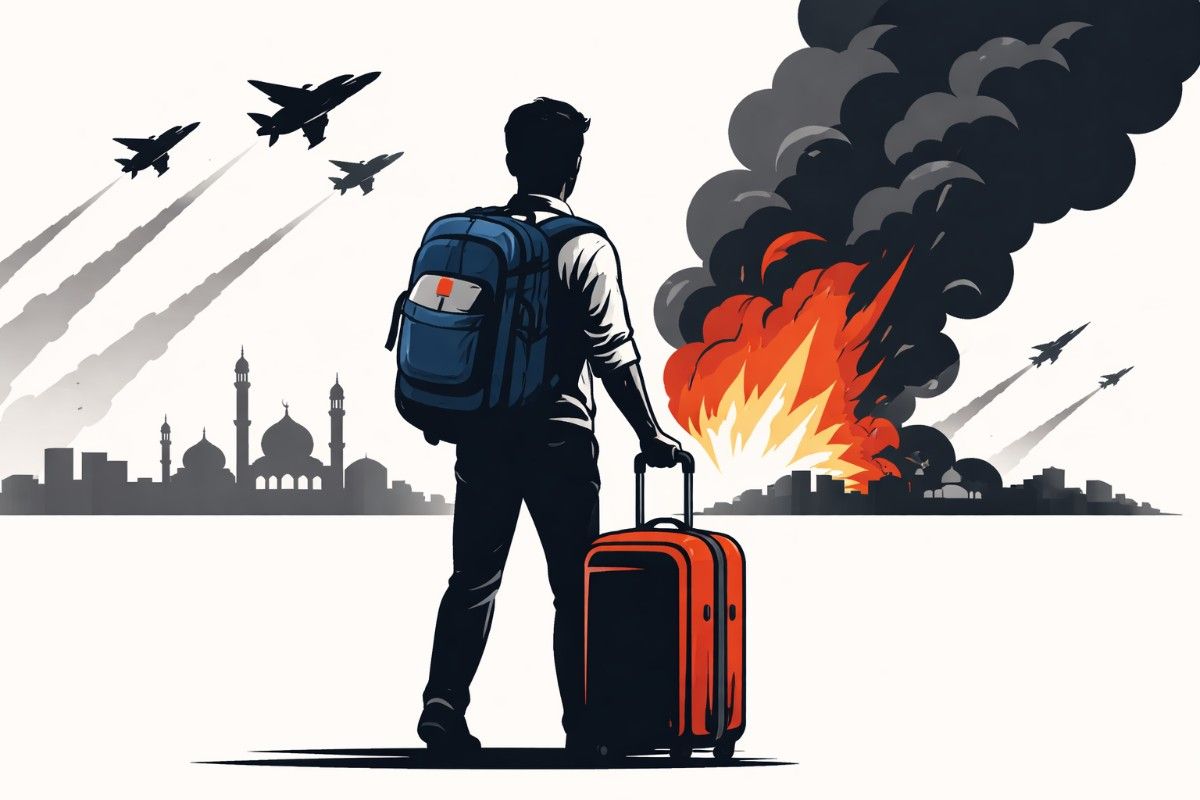
The escalating conflict between Iran and Israel is beginning to directly affect thousands of Indian nationals across West Asia, triggering widespread flight disruptions, fresh embassy advisories and renewed concerns over possible evacuation measures. While the security situation varies across countries in the region, the aviation fallout has already caused immediate and visible disruption for Indian travellers and expatriates.
Airspace restrictions imposed across parts of the Middle East have led to cancellations, diversions and longer flight routes. Indian carriers operating international services through affected corridors have announced schedule adjustments. IndiGo cancelled multiple international flights on March 1 and 2 citing operational constraints linked to regional airspace closures. Similarly, Air India suspended certain West Asia services and rerouted long-haul flights to Europe and North America to avoid sensitive air corridors. These changes have increased travel time for some passengers and led to missed connections at major transit hubs.
The disruption has been especially challenging for Indians transiting through Gulf airports such as Dubai and Abu Dhabi, which function as critical global connectors for passengers travelling between India and Western destinations. Indian authorities confirmed they are in touch with UAE officials to assist stranded passengers. The Indian mission in the UAE has advised affected travellers to remain in contact through official helplines while airlines work to restore normal operations.
At Indian airports, the ripple effect has been visible as well. Several international departures were cancelled or delayed due to aircraft positioning and route adjustments. Aviation officials say safety considerations remain paramount, and airlines are continuously reviewing flight paths in coordination with international aviation authorities.
Beyond travel concerns, the Ministry of External Affairs has intensified advisories for Indian nationals residing in Israel and Iran. The Embassy of India, Tel Aviv has urged Indian citizens in Israel to exercise utmost caution, follow local safety instructions and avoid unnecessary movement. Emergency contact channels remain active for assistance.
In Iran, the advisory has been more urgent. The Embassy of India, Tehran issued a notice dated February 23, 2026, advising Indian nationals — including students, pilgrims and business travellers — to leave the country using available commercial means where feasible and to remain in close contact with the mission. According to recent parliamentary disclosures, there are approximately 9,000 to 10,000 Indian nationals across various provinces in Iran.
At this stage, the government has not announced a fresh evacuation operation. Officials have clarified that while the situation is being closely monitored, Indians are currently being advised to use commercial travel options wherever operationally possible. This differs from June 2025, when India launched Operation Sindhu, evacuating over 4,400 Indian nationals from Iran and Israel during a previous phase of heightened tensions.
The current crisis has also highlighted vulnerabilities beyond aviation. In a separate incident linked to regional hostilities, an oil tanker was struck near Oman in the Strait of Hormuz, prompting the evacuation of crew members that included Indian nationals. Maritime routes through the Gulf remain strategically critical for global energy supplies and for Indian seafarers working aboard international vessels.
For Indian families back home, uncertainty remains the dominant concern. Parents of students in Iranian universities and families of professionals working across the Gulf have been closely tracking embassy advisories and airline updates. State governments in India have also begun coordinating with the Centre to monitor the welfare of residents from their respective states who may be affected.
Experts say the immediate trajectory will depend on whether airspace restrictions expand or begin to ease. If the conflict intensifies further, additional flight suspensions could follow, increasing pressure on diplomatic missions and airlines to provide assistance. For now, officials continue to stress vigilance, adherence to local safety instructions and regular communication with Indian embassies.
West Asia hosts one of the world’s largest Indian diaspora populations, particularly in the Gulf countries. While daily life in many parts of the region remains stable, the aviation disruption underscores how geopolitical escalation can quickly spill over into civilian mobility and expatriate safety. As the situation evolves, Indian authorities say safeguarding citizens abroad remains a priority, with contingency planning in place should conditions require stronger intervention.
Disclaimer: The information presented in this article is intended for general informational purposes only. While every effort is made to ensure accuracy, completeness, and timeliness, data such as prices, market figures, government notifications, weather updates, holiday announcements, and public advisories are subject to change and may vary based on location and official revisions. Readers are strongly encouraged to verify details from relevant official sources before making financial, investment, career, travel, or personal decisions. This publication does not provide financial, investment, legal, or professional advice and shall not be held liable for any losses, damages, or actions taken in reliance on the information provided.
Edited by Madhusudhan Reddy
Last Updated on: Monday, March 2, 2026 10:18 am by News Proton Team | Published by: News Proton Team on Monday, March 2, 2026 10:18 am | News Categories: General