
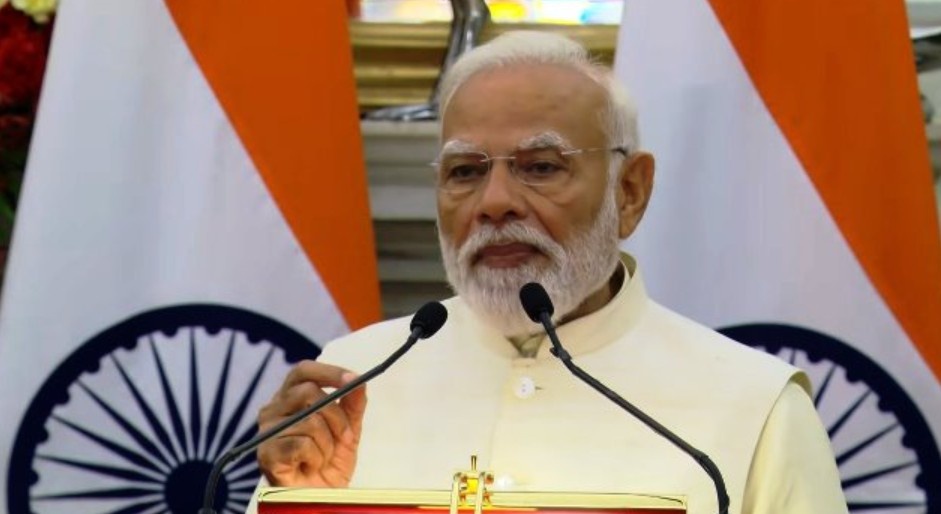
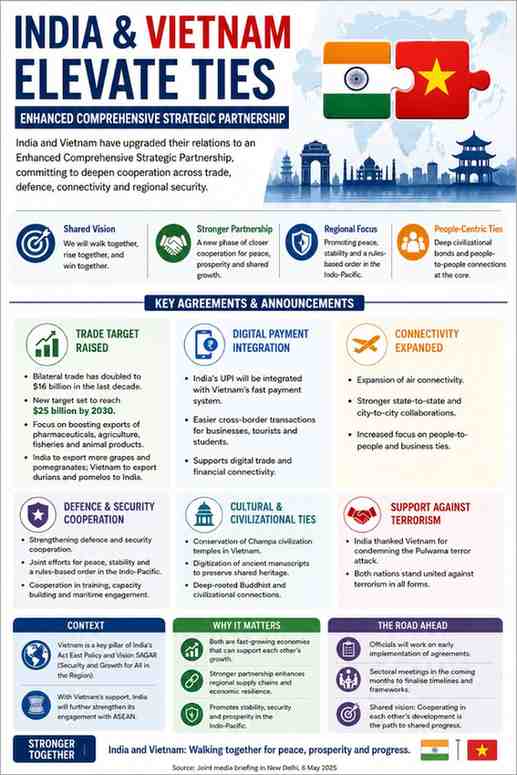
India and Vietnam have agreed to deepen cooperation across trade, defence, digital payments, and connectivity as both countries elevate their bilateral relationship to an enhanced Comprehensive Strategic Partnership.
Prime Minister Narendra Modi and Vietnamese President To Lam on Wednesday announced a significant expansion of India-Vietnam ties following high-level discussions in New Delhi. The two countries outlined plans to strengthen economic engagement, defence cooperation, and regional strategic coordination, particularly in the Indo-Pacific region.
Speaking after the talks, Prime Minister Modi said the relationship between India and Vietnam was entering a new phase focused on shared growth and long-term collaboration.
“We will walk together, rise together, and win together,” Modi said during the joint media briefing.
India and Vietnam Expand Strategic Cooperation
The announcement marks a major step in relations between the two countries, which have steadily grown closer over the past decade under India’s “Act East Policy” — a diplomatic and economic initiative aimed at strengthening ties with Southeast Asia.
Both sides agreed to intensify cooperation in sectors including trade, defence, digital infrastructure, agriculture, and connectivity. Officials also discussed expanding engagement between Indian and Vietnamese states and cities to encourage investment and people-to-people exchanges.
Prime Minister Modi described Vietnam as a “key pillar” of India’s Indo-Pacific strategy and Vision SAGAR, India’s maritime framework aimed at ensuring regional security and cooperation in the Indian Ocean region.
The leaders also reaffirmed support for maintaining peace, stability, and a rules-based order in the Indo-Pacific, an area that has gained increasing geopolitical importance amid regional security concerns and global trade competition.
Bilateral Trade Target Raised to $25 Billion
India and Vietnam said bilateral trade has doubled over the last decade, reaching approximately $16 billion. Both countries have now set a target of increasing trade volumes to $25 billion by 2030.
To support this goal, the two sides agreed to facilitate greater market access for agricultural and food products. India is expected to increase exports of fruits such as grapes and pomegranates to Vietnam, while Vietnamese products including durians and pomelos are likely to enter the Indian market in larger quantities.
The discussions also covered pharmaceuticals, fisheries, and animal products, sectors where both countries see strong potential for growth.
UPI-Vietnam Payment Integration Planned
In a move aimed at strengthening financial connectivity, India and Vietnam agreed to work towards linking India’s Unified Payments Interface (UPI) with Vietnam’s fast payment system.
The proposed integration could make cross-border transactions easier for businesses, tourists, and students, while also supporting digital trade between the two economies.
India has increasingly promoted UPI internationally as part of its digital public infrastructure outreach, with several countries already exploring payment linkages with the Indian platform.
Defence and Regional Security Remain Key Focus
Defence cooperation emerged as another major area of discussion during the bilateral talks. Both nations agreed to further strengthen security ties and strategic coordination in the Indo-Pacific region.
India and Vietnam have expanded defence engagement in recent years through naval cooperation, military training, and defence capacity-building initiatives. Analysts view the growing partnership as strategically important due to both countries’ shared interest in ensuring maritime security and maintaining freedom of navigation in the region.
Modi also said India would continue strengthening its engagement with the Association of Southeast Asian Nations (ASEAN) with Vietnam’s support.
Cultural and Civilizational Ties Highlighted
The leaders also emphasized the historical and cultural links between the two nations. Prime Minister Modi referred to ongoing efforts to preserve temples linked to the ancient Champa civilization in Vietnam and initiatives aimed at digitizing ancient manuscripts.
India and Vietnam share long-standing Buddhist and civilizational connections that continue to shape cultural cooperation between the two countries.
India Thanks Vietnam for Support Against Terrorism
During the media briefing, Prime Minister Modi thanked Vietnam for expressing solidarity with India following the Pulwama terror attack and for supporting India’s position against terrorism.
The Pulwama attack in 2019, in which 40 Indian security personnel were killed, led to heightened diplomatic efforts by India to strengthen international cooperation against terrorism.
Why the Partnership Matters
The upgraded partnership comes at a time when both India and Vietnam are among Asia’s fastest-growing economies and are seeking to diversify trade and strategic partnerships amid global economic uncertainty.
For India, deeper ties with Vietnam strengthen its presence in Southeast Asia and reinforce its broader Indo-Pacific strategy. For Vietnam, stronger engagement with India offers opportunities in trade, technology, defence, and infrastructure cooperation.
The latest agreements are also expected to support regional supply chains and improve economic resilience for both countries.
What Happens Next
Officials from both sides are expected to begin implementing the agreements announced during the visit, particularly in areas related to trade facilitation, digital payments, connectivity, and defence cooperation.
The two countries are also likely to hold follow-up sectoral discussions in the coming months to outline timelines and operational frameworks for the initiatives announced during the bilateral talks.
Input & Images : Hindusthan Samachar
Edited by Madhusudhan Reddy
Last Updated on: Wednesday, May 6, 2026 7:10 pm by News Proton Team | Published by: News Proton Team on Wednesday, May 6, 2026 7:10 pm | News Categories: Trending, General, India